Budgeting
How to Create a Monthly Spending Plan You Can Actually Follow

A monthly budget and a monthly spending plan sound like the same thing, but they solve slightly different problems. The budget is the set of numbers — how much goes where. The spending plan is what actually happens once the month is underway and real life starts pulling against those numbers. A lot of budgets that look reasonable on paper still fall apart in practice because the execution side was never really planned.
Why Spending Plans Fall Apart Mid-Month
The most common failure point isn't the numbers themselves — it's the absence of any check-in between building the plan and reviewing it at the end of the month. Without something in between, a category that's quietly running over has weeks to keep drifting before anyone notices, by which point there's little room left to correct course.
Step 1: Start From a Real Budget, Not a Wish List
A spending plan only works if it's built on numbers that reflect actual spending patterns, not an idealized version of what you'd like to spend. If your monthly budget hasn't been checked against real recent spending, start there — a plan built on unrealistic numbers is set up to fail regardless of how well it's executed afterward.
Step 2: Build In Deliberate Flexibility
A spending plan with zero flexibility in any category tends to break the first time something doesn't go exactly as planned. Identifying one or two categories that can flex a bit if needed — and being explicit about which ones — gives the plan room to bend without falling apart entirely when a normal, everyday variation shows up.
Step 3: Add a Weekly Check-In
A single end-of-month review catches problems too late to actually fix them. A brief weekly check-in — comparing actual spending in each category against where it should be at that point in the month — catches drift early enough to still make a meaningful adjustment. This doesn't need to be elaborate; a five-minute glance at running totals is usually enough.
Step 4: Pre-Decide How You'll Handle Going Over
Deciding in advance how an over-budget category will be handled — which other category flexes to compensate, or what the response looks like — means you're not making that decision reactively, under stress, in the moment it happens. A plan is much easier to actually follow when the response to a predictable problem is already decided.
Step 5: Separate Fixed Costs From the Parts That Need Active Management
Fixed costs (rent, a loan payment, a subscription) don't need active daily attention — they're the same every month. The spending plan's real value is in the variable categories: groceries, dining out, discretionary spending — the ones that actually require ongoing decisions throughout the month. Focusing the weekly check-in on these categories specifically, rather than the whole budget, keeps the process lightweight and sustainable.
Example: A Spending Plan With Built-In Flexibility
A monthly budget allocates $500 to groceries and $150 to dining out. Rather than treating these as two rigid, separate limits, the spending plan treats them as a combined $650 "food" category with some flexibility between the two — if dining out runs a little higher one week, a corresponding reduction in the grocery budget absorbs it, rather than requiring an immediate correction or treating the overage as a failure.
What a Weekly Check-In Actually Looks Like
A weekly check-in doesn't need to be a full audit — it's a quick comparison: is each flexible category roughly where it should be at this point in the month? A category that's already at 80% of its monthly total by week two is a clear, early signal to adjust, well before the situation becomes a real problem by month's end.
Planning for Known Upcoming Variations
If a specific week or two within the month is already known to be different — a planned trip, a holiday, a busier social stretch — building that variation into the plan from the start, rather than treating it as an exception once it happens, keeps the plan realistic instead of setting up an automatic overage the moment something predictable occurs.
Adjusting the Plan Without Abandoning It
A spending plan that isn't working exactly as designed doesn't need to be scrapped — it needs a specific adjustment. If a category consistently runs over regardless of effort, that's useful information: either the original number wasn't realistic, or that category needs more built-in flexibility going forward. Revising the plan based on real data, rather than assuming more willpower will fix it, tends to produce a version that actually holds up.
Involving Everyone the Plan Affects
If the budget covers more than one person — a partner, a family — making sure everyone involved knows the plan and the weekly check-in process, not just the person who built it, prevents a common failure point where the plan exists on paper but only one person is actually tracking or aware of it. A spending plan that only one household member knows about tends to break down the moment spending decisions are made by someone else.
Common Mistakes
No check-in between building the plan and reviewing it at month's end. This is the single most common reason a reasonable-looking plan falls apart in practice — a mid-month checkpoint catches problems while there's still time to act.
Zero flexibility anywhere in the plan. A plan with no room to bend breaks the first time something doesn't go exactly as expected — deliberate flexibility in a category or two makes the whole plan more durable.
Treating one over-budget category as total failure. A single category running over doesn't undo the rest of the plan — a pre-decided adjustment elsewhere usually resolves it without requiring the whole month to be treated as a loss.
Building the plan from ideal numbers instead of real ones. A spending plan based on what you'd like to spend, rather than what you actually tend to spend, sets up a mismatch between the plan and reality from the very start.
Using Tools That Make the Check-In Easier
The weekly check-in is far more likely to actually happen if it's quick and low-friction — a simple running total per category, whether in an app, a spreadsheet, or even a printed tracker, removes most of the barrier to actually doing it consistently. The specific tool matters less than whether it makes the five-minute check genuinely easy enough to become a real habit rather than another task that gets postponed.
A Plan Built for Execution, Not Just for Looking Good on Paper
The difference between a spending plan that survives the month and one that quietly falls apart by the second week usually isn't the numbers — it's whether there's a real process for checking in and adjusting along the way. Built with deliberate flexibility and a regular, lightweight check-in, a spending plan becomes something you can actually follow, not just something that looked reasonable when it was first written down.
For a Weekly Spending Tracker built to make mid-month check-ins fast and automatic, The Money Clarity System includes tools designed to support exactly this kind of ongoing, realistic plan.
Frequently asked questions
How is a spending plan different from a monthly budget?
[A monthly budget](/blog/how-to-create-a-monthly-budget) is the numbers themselves — how much is allocated to each category. A spending plan is more about the execution: the specific habits and checkpoints that keep actual spending aligned with those numbers as the month unfolds.
Why does my spending plan usually fall apart by mid-month?
This often happens when a plan is built with categories that are too tight, with no buffer for normal variation, or with no mid-month check-in to catch drift early — by the time it's noticed, there's little room left to adjust.
How often should I check my spending plan during the month?
A weekly check-in tends to work well for most people — frequent enough to catch a category running over while there's still time to adjust, without requiring daily tracking that's hard to sustain.
What if I go over budget in one category?
Going over in one category isn't a failure of the whole plan — adjusting a different, more flexible category to compensate for the rest of the month is usually more effective than abandoning the plan entirely.
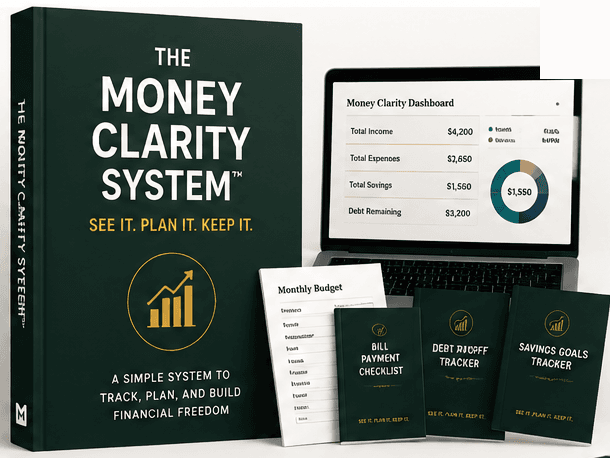
The Money Clarity System™
Ready to actually track it, not just read about it?
The full guide, dashboard, planner, challenges, and bonuses — one payment, lifetime access.
Related articles

Budgeting
How to Create a Monthly Budget (That Fits Your Actual Paycheck)
A monthly budget only works if it matches how income actually arrives — not a single averaged total that ignores the timing of real paychecks and real bills.
4 min read

Financial Goals
The Weekly Money Check-In: A Short Habit That Prevents Big Problems
A weekly money check-in catches an overspending category or a stalled goal while there's still time to adjust — a monthly-only review usually catches it too late.
3 min read

Expense Tracking
How to Review Your Monthly Spending (A Simple Process)
Tracking spending without reviewing it is only half the process. A short, structured monthly review is what actually turns data into a better plan.
3 min read