Budgeting
How to Budget for Annual and Irregular Expenses

The monthly bills rarely sink a budget — rent, groceries, utilities are usually accounted for. What tends to cause real damage is the expense that shows up once a year, gets forgotten in the eleven months between occurrences, and then lands like an emergency even though it happens on a completely predictable schedule.
Why Irregular Expenses Do More Damage Than Their Dollar Amount Suggests
A $900 annual insurance premium isn't actually a large expense relative to most household budgets — spread across 12 months, it's $75. The problem isn't the size; it's that it usually isn't spread out at all. It arrives as one lump-sum bill, at a moment when the regular monthly budget wasn't built to absorb an extra $900, because nobody planned for it in any of the eleven months before it showed up.
This is the core issue with irregular expenses: they're financially small on a monthly basis but psychologically and practically large when they land all at once, unbudgeted.
Step 1: Build a Full List From the Last 12 Months
This step requires looking back further than a typical monthly budget review. Pull bank and credit card statements for the past year and list every expense that wasn't monthly. A fairly complete list often includes:
- Auto or home insurance, if billed semi-annually or annually
- Property tax, if not escrowed into a mortgage
- Car registration and inspection fees
- Annual subscriptions or memberships
- Holiday and gift spending
- Back-to-school costs
- Annual or semi-annual medical, dental, or vision costs not covered by insurance
- Home or car maintenance that's foreseeable, even without an exact date
- Annual professional fees, licenses, or dues
Missing this step and just budgeting month to month is the single most common reason irregular expenses keep feeling like surprises — they're not visible in a 30-day view, so they never get planned for.
Step 2: Total the Annual Cost and Convert to a Monthly Number
Add up every irregular expense from the list, then divide by 12. This is the amount that needs to be set aside every month, regardless of whether anything is actually due that particular month.
Example:
| Irregular expense | Annual cost |
|---|---|
| Auto insurance (semi-annual) | $1,240 |
| Car registration | $180 |
| Holiday spending | $500 |
| Home maintenance | $700 |
| Annual subscriptions | $220 |
| Total | $2,840 |
$2,840 ÷ 12 = $237/month
That $237 gets built into the regular monthly budget exactly like rent or a car payment — not as an occasional expense to "figure out later," but as a fixed monthly commitment toward a fund that absorbs the actual bills as they land.
Step 3: Keep the Money Separate From Regular Spending
The monthly amount needs somewhere to accumulate between now and whenever each specific bill comes due — a dedicated savings account, or a clearly labeled category within a budgeting tool. If it just sits in the main checking account undifferentiated from regular spending money, it tends to get absorbed into everyday purchases well before the annual insurance bill actually arrives.
This is the same underlying idea as a sinking fund, applied across the full list of irregular expenses at once rather than one category at a time.
Step 4: Track Which Bills Are Coming Up Each Month
Even with the fund building steadily, it helps to know which specific irregular expenses are due in the near term. A simple running list — "car registration due in March, holiday spending needed by December, insurance renewal in June" — turns the fund from a vague cushion into a clearly mapped set of upcoming withdrawals.
Step 5: Adjust the Estimate Every Few Months
Irregular expenses change — insurance premiums increase at renewal, a subscription gets added or cancelled, holiday spending runs higher or lower than the previous year. Reviewing the list and the monthly contribution amount every three to six months keeps the fund accurate instead of gradually drifting out of sync with what's actually being spent.
Irregular Expenses vs. Sinking Funds: How They Relate
The system described here and the concept of a sinking fund are closely related — a sinking fund is really just the mechanism for funding one specific irregular expense, applied one category at a time. The full irregular-expenses system described in this guide is the broader practice of identifying every non-monthly expense at once and building a single combined monthly contribution to cover all of them together, rather than setting up and tracking each one separately.
Either approach works. Some people prefer several clearly labeled, separate funds — "Car Registration: $135 of $180," "Holiday: $310 of $500" — because the specificity keeps each goal concrete. Others prefer one combined "irregular expenses" pool with a single running total, because it's simpler to maintain and requires less ongoing categorization. The right choice is whichever one actually gets maintained consistently.
A Second Example: A Household With Fewer Irregular Expenses
Not every household has a long list. A simpler example, for someone with just two or three genuinely irregular costs:
| Irregular expense | Annual cost |
|---|---|
| Car registration | $150 |
| Annual software subscription | $120 |
| Holiday spending | $350 |
| Total | $620 |
$620 ÷ 12 = $52/month
Even a short list benefits from this treatment — $52 a month is a manageable, easy-to-forget-about contribution, while $620 landing unplanned across two or three separate months can still create real strain in an otherwise well-managed budget.
What if the Fund Runs Short When a Bill Arrives?
Even a well-calculated irregular expenses fund can occasionally fall short — a bill comes in higher than the previous year, or a bill arrives earlier in the fund's buildup cycle than expected. When this happens, covering the gap from a different month's discretionary spending, rather than a credit card, keeps the shortfall from becoming ongoing debt. The following month's contribution estimate can then be adjusted upward if the higher cost turns out to be a new normal rather than a one-time increase.
Where This Fits Relative to an Emergency Fund
It's worth being explicit about the boundary between an irregular-expenses fund and an emergency fund, since the two can start to blur without a clear rule. The irregular-expenses fund covers costs that are certain to happen, even if the exact date or amount isn't perfectly known — insurance, holidays, registration. The emergency fund exists for costs that might never happen at all, and hopefully don't — a job loss, an unplanned medical bill, a major unexpected repair.
Drawing from the emergency fund to cover a known, predictable irregular expense — because the irregular-expenses fund wasn't built up in time — technically solves the immediate problem, but it leaves the emergency fund smaller heading into a period where an actual emergency could still happen. Keeping the two funds genuinely separate, even if that means a predictable expense occasionally has to be covered by trimming that month's discretionary spending instead, protects the emergency fund's core purpose.
What Happens Without This System
Without a dedicated plan, irregular expenses tend to get covered one of three ways: a credit card absorbs the cost and adds interest to what should have been a manageable, foreseeable bill; money gets pulled from an emergency fund that was meant for genuine surprises, leaving it smaller the next time a real emergency happens; or a different budget category gets raided that month, creating a ripple effect that shows up as "overspending" somewhere else entirely.
None of these are failures of the budget itself — they're the predictable result of a budget that only accounts for monthly expenses, applied to a category of spending that isn't monthly at all.
A Budget That Actually Holds Up All Year
A monthly budget that balances perfectly for eleven months and then gets blown up by a bill in month twelve isn't really working — it's just working most of the time. Building irregular and annual expenses into the plan from the start, with their own monthly contribution and their own separate holding place, is what turns "the budget mostly works" into "the budget actually holds up, including December, including the month the car needs new tires."
Once irregular expenses have a monthly number and a plan, The Money Clarity System gives you a place to track that category alongside your regular budget, debt payoff, and savings goals — all in one dashboard instead of scattered across memory and bank statements.
Frequently asked questions
What's the difference between an irregular expense and an emergency expense?
An irregular expense is fully predictable — it will happen, on a roughly known schedule, for a roughly known amount. An emergency expense is genuinely unplanned. Car registration is irregular; a surprise transmission failure is an emergency. Treating irregular expenses as if they were emergencies is one of the most common budgeting mix-ups.
How far back should I look to estimate annual expenses?
The last 12 months, if that history is available — a full year captures expenses that only happen once, like an annual insurance premium or a holiday season, which a shorter window would miss entirely.
What if an irregular expense comes in higher than expected?
Adjust the monthly estimate going forward, and treat the current gap as a one-time shortfall to cover from a buffer or by trimming elsewhere that month, rather than assuming the original estimate will average out on its own next time.
Should irregular expenses be budgeted separately from monthly expenses?
Yes — combining them into regular monthly categories tends to hide the actual monthly cost, since a category that's usually $0 and occasionally $600 doesn't average cleanly in a simple month-by-month view. A separate irregular-expenses total, funded monthly in small amounts, keeps the picture accurate.
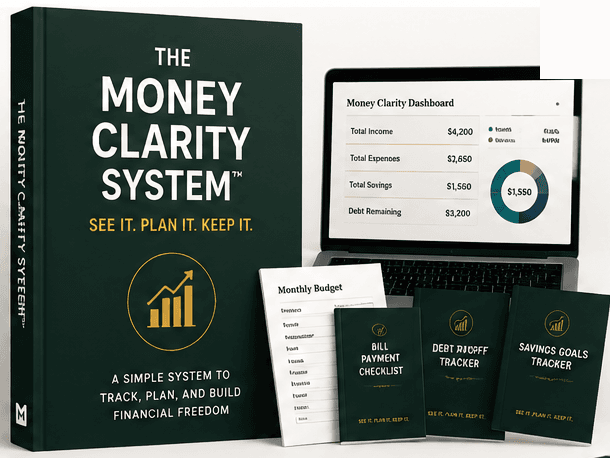
The Money Clarity System™
Ready to actually track it, not just read about it?
The full guide, dashboard, planner, challenges, and bonuses — one payment, lifetime access.
Related articles

Budgeting
What Is a Sinking Fund? A Simple Way to Stop Budget Surprises
A sinking fund is a savings bucket for a specific, predictable future expense — the opposite of an emergency fund, which exists for the unpredictable ones.
8 min read

Budgeting
How to Create a Monthly Budget (That Fits Your Actual Paycheck)
A monthly budget only works if it matches how income actually arrives — not a single averaged total that ignores the timing of real paychecks and real bills.
4 min read

Money Management
The Monthly Financial Checkup: A Simple Recurring Routine
A monthly financial checkup is broader than a spending review — it's a short routine that checks the whole picture: budget, savings, debt, and goals together.
3 min read