Debt Management
What Is Debt-to-Income Ratio and Why It Matters for Your Budget

A paycheck can look perfectly reasonable on paper and still feel tight every single month — and debt-to-income ratio is often the number that explains why. It's a simple calculation that reveals exactly how much of every dollar earned is already spoken for before it ever reaches a checking account.
What Debt-to-Income Ratio Actually Measures
Debt-to-income ratio, usually shortened to DTI, compares total monthly debt payments to gross monthly income (income before taxes and deductions). It's expressed as a percentage, and it answers one specific question: out of every dollar earned, how much is committed to debt obligations before anything else — rent, groceries, savings — gets a turn.
It's a number lenders use heavily when evaluating mortgage, auto loan, and other credit applications, but it's just as useful as a personal check-in, independent of any application in progress.
How to Calculate Debt-to-Income Ratio
The formula: total monthly debt payments ÷ gross monthly income × 100.
What counts as a debt payment:
- Rent or mortgage payment
- Car loan payment
- Student loan payment
- Personal loan payment
- Credit card minimum payments (not the full balance — just the minimum due)
- Any other recurring loan payment
What doesn't count:
- Groceries, utilities, insurance premiums, subscriptions
- Everyday variable spending
- Savings contributions
A worked example:
| Monthly debt payment | Amount |
|---|---|
| Rent | $1,400 |
| Car loan | $320 |
| Student loan | $210 |
| Credit card minimum | $90 |
| Total monthly debt | $2,020 |
Gross monthly income: $5,800
$2,020 ÷ $5,800 = 0.348 → 34.8% DTI
What Counts as a "Good" Ratio
There's no single universal cutoff, but a few commonly referenced ranges give useful context:
- Below 36% is generally considered reasonably healthy by many lenders and financial guidelines.
- 36% to 43% is a range where some flexibility exists, but it's getting tighter — often the range where a mortgage lender starts looking more closely at other factors.
- Above 43% is frequently cited as a common upper threshold for conventional mortgage qualification, though specific limits vary by lender and loan type.
- Above 50% generally leaves very little room in a budget for savings, unplanned expenses, or any financial flexibility at all.
These are reference points, not verdicts — a 40% DTI with strong savings habits and no other financial stress is a different situation than a 40% DTI with no emergency fund and rising credit card balances. The number is most useful as a starting point for a conversation with yourself about the budget, not a final grade.
Why This Number Matters Beyond Loan Applications
Even for someone with no near-term plans to apply for a mortgage or auto loan, DTI is a genuinely useful personal metric, because it makes visible something a monthly budget can sometimes obscure: the proportion of income that's structurally committed before any spending decision even happens.
A household earning $8,000 a month with $3,200 in debt payments (40% DTI) and a household earning $4,000 a month with $1,600 in debt payments (also 40% DTI) are in a strikingly similar structural position, even though the dollar amounts look completely different. The ratio reveals that similarity in a way raw dollar figures don't.
How to Lower Debt-to-Income Ratio
There are really only two levers: reduce the debt payments, or increase the income. Most realistic progress comes from working the first lever, since it's more directly controllable.
Pay down debts with the highest monthly payment relative to their balance. Sometimes a smaller balance with a large minimum payment (a personal loan on a short term, for example) has more effect on DTI than a larger balance with a small minimum payment.
Avoid taking on new debt payments while working the ratio down. Every new loan or credit line with a monthly payment moves the number in the wrong direction, even if the purchase itself feels justified.
Refinance where it genuinely reduces the monthly payment, not just the interest rate — DTI cares specifically about the monthly obligation, so a refinance that extends the term to lower the payment does help the ratio, even though it may mean paying more in total interest over time. That tradeoff is worth weighing carefully, not assumed to be automatically worth it.
Increase income where realistic — a raise, a side income stream, or additional consistent earnings all lower the ratio by growing the denominator, even with debt payments unchanged.
Avoid closing paid-off accounts that carry no ongoing payment. DTI is about payments, not the number of accounts, so this move affects credit history more than it affects DTI directly — worth knowing so it doesn't get pursued as a DTI strategy when it isn't one.
Front-End vs. Back-End Ratio
Lenders, particularly mortgage lenders, sometimes break debt-to-income ratio into two separate numbers rather than one combined figure:
Front-end ratio looks only at housing costs — rent or projected mortgage payment, including property tax and insurance where applicable — divided by gross monthly income.
Back-end ratio is the broader number described above: all monthly debt payments, including housing, divided by gross monthly income.
Example, using the earlier household:
| Amount | Ratio | |
|---|---|---|
| Housing only (front-end) | $1,400 | 24.1% |
| All debt payments (back-end) | $2,020 | 34.8% |
A lender might have separate thresholds for each — commonly citing a front-end ratio around 28% and a back-end ratio around 36% as general reference points for conventional mortgage guidelines, though actual limits vary by loan type and lender. For personal budgeting purposes outside of a loan application, the back-end (total) ratio is usually the more complete picture, since it captures every debt obligation, not just housing.
How DTI Interacts With an Emergency Fund
A high debt-to-income ratio and a thin emergency fund are a particularly risky combination, even if neither one alone is at a crisis level. A household with 40% DTI and six months of expenses saved has real flexibility if income drops temporarily — debt payments can still be made while other spending gets cut. A household with the same 40% DTI and no emergency fund has almost no room to absorb any disruption at all, since that large a share of income is already locked into fixed obligations before anything else.
This is part of why DTI is worth tracking even outside of a specific loan application — it's a useful signal for how much cushion actually exists in a budget, not just a lender's checkbox.
A Second Worked Example, Showing Improvement Over Time
Seeing the ratio move is often more motivating than seeing it as a single static number. Here's what six months of a deliberate debt paydown plan can look like:
| Month | Total monthly debt payments | Gross monthly income | DTI |
|---|---|---|---|
| Month 1 | $2,020 | $5,800 | 34.8% |
| Month 3 | $1,890 | $5,800 | 32.6% |
| Month 6 | $1,720 | $5,800 | 29.7% |
None of these individual monthly changes look dramatic — a percentage point or two at a time — but tracked over six months, the trend line makes the progress of a debt payoff plan visible in a way that just watching individual account balances shrink doesn't always convey as clearly. It's the same underlying progress, viewed through a different, sometimes more motivating lens.
What DTI Doesn't Capture
It's worth being clear about the limits of this number. Debt-to-income ratio doesn't account for the interest rate on any given debt — a $300 monthly payment on a 24% credit card and a $300 monthly payment on a 4% car loan affect DTI identically, even though they represent very different financial situations. It also doesn't account for savings, assets, or how much is left over after debt payments and essential expenses.
This is why DTI is best used as one input among several — alongside a real look at interest rates, an emergency fund balance, and the categories in a full monthly budget — rather than the single number that determines whether finances are "good" or "bad."
Checking the Number Periodically
DTI isn't a one-time calculation — it shifts every time an old loan is paid off, a new one is taken on, or income changes. Checking it every few months, alongside a broader review of debt balances and a payoff plan, turns it from an abstract lender concept into a genuinely useful personal progress marker: a number that should be trending down as a payoff plan works, even before every individual balance hits zero.
If your ratio is higher than you'd like, The Money Clarity System includes a debt payoff tracker built to help you plan which balances to target first — and see the total monthly obligation shrink as you go.
Frequently asked questions
What debts count toward debt-to-income ratio?
Recurring debt payments with a fixed minimum: rent or mortgage, car loans, student loans, personal loans, and credit card minimum payments. Everyday variable expenses like groceries, utilities, or subscriptions are not included — DTI is specifically about debt obligations, not total spending.
Is debt-to-income ratio the same as a credit score?
No. A credit score reflects payment history, credit usage, and account age, among other factors. Debt-to-income ratio is a separate calculation — often used by lenders alongside a credit score, but it's not a factor in the score itself. It's possible to have a strong credit score and a high DTI at the same time.
What counts as a 'good' debt-to-income ratio?
Many lenders consider 36% or below reasonably healthy, with 43% often cited as a common upper threshold for mortgage qualification. These are general reference points, not fixed rules — the more useful question for personal budgeting purposes is usually whether the current ratio leaves enough room for savings and unplanned expenses, not just whether it clears a lender's cutoff.
Does paying off a credit card in full each month affect DTI?
Debt-to-income ratio typically uses the minimum payment due, not the full balance — so a credit card paid in full each month still contributes its minimum payment to the calculation for that billing cycle, even though no interest accrues. Carrying a lower balance generally means a lower minimum payment, which does help the ratio somewhat.
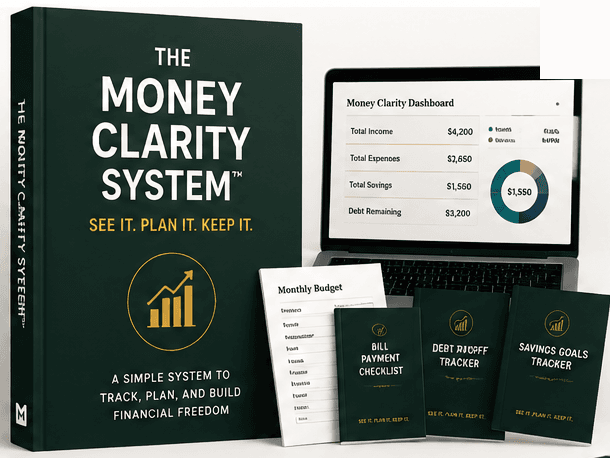
The Money Clarity System™
Ready to actually track it, not just read about it?
The full guide, dashboard, planner, challenges, and bonuses — one payment, lifetime access.
Related articles

Debt Management
How Much Should You Put Toward Debt Each Month?
Putting every spare dollar toward debt feels responsible, but it can leave no room for anything else — including the cushion that prevents new debt.
4 min read

Debt Management
How to Create a Debt Payoff Plan (With a Real Timeline)
A list of debts isn't a plan. A plan has an order, a monthly number, and a realistic date attached — here's how to build one from scratch.
3 min read

Debt Management
How to Pay Off Debt: A Complete, Realistic Guide
Paying off debt isn't complicated in concept — it's a specific process that most people never actually lay out in full. Here's the complete version.
3 min read