Money Management
How to Organize Your Finances in One Weekend

Getting your finances fully organized can feel like a project that never quite gets started, because it's easy to imagine it as a much bigger undertaking than it actually needs to be. This is a focused version: a checklist built to be completed in a single weekend, covering the essentials — not a complete long-term system, but enough to move from scattered to genuinely functional.
Why a Weekend-Length Approach Works
A full financial organization system is worth building eventually, but starting there can feel overwhelming enough to delay starting at all. A time-boxed weekend version, focused on the essentials, gets the most important pieces in place quickly — after which a fuller, ongoing system becomes a much easier next step, if you want to build one.
Saturday Morning: Gather Everything
Start by listing every account you have — checking, savings, credit cards, loans, retirement accounts — in one place. This doesn't need to be elaborate, just complete. A surprising amount of financial disorganization comes simply from not having a full picture of what accounts exist in the first place.
Saturday Midday: Audit Recurring Charges
Pull up the last one to two months of statements across your accounts and list every recurring charge — subscriptions, memberships, automatic payments. For each one, decide: keep, cancel, or downgrade. This single step often uncovers charges that have been running unnoticed for months. Tracking recurring expenses covers this process in more depth if you want to build it into an ongoing habit afterward.
Saturday Afternoon: List All Bills and Due Dates
Build a simple list of every regular bill and its due date — rent or mortgage, utilities, loan payments, insurance. Having this in one place, rather than scattered across emails and paper mail, is one of the most immediately useful outputs of the whole weekend.
Saturday Evening: Set Up Basic Automatic Payments
For bills that don't already have automatic payment set up, this is a good point to do it — for at least the fixed, predictable ones. This reduces the ongoing mental load of remembering to pay each bill manually every month, freeing up attention for the parts of your finances that actually need active decisions.
Sunday Morning: Build a Basic Monthly Budget
Using the bill list from Saturday and your actual take-home income, sketch out a basic monthly budget — fixed bills, essential variable categories (groceries, transportation), and whatever's left over. This doesn't need to be a polished, final version; a working first draft is enough for now. Building a full monthly budget covers this step in more depth if you want to refine it further afterward.
Sunday Midday: Check In on Debt and Savings
Note the current balance and interest rate on any debt, and the current balance in any savings accounts. This doesn't require a full payoff plan or savings strategy this weekend — just an accurate, current snapshot to work from going forward.
Sunday Afternoon: Set Up One Ongoing Habit
Before the weekend wraps up, decide on one small, sustainable habit to keep things from sliding back into disorganization — a weekly money check-in, a monthly bill review, whatever fits realistically into your routine. Organizing everything once and then never revisiting it tends to drift back toward disorder within a few months.
Example: A Realistic Weekend Outcome
By Sunday evening, a household that started with scattered, unclear finances has: a full list of accounts, a reviewed and trimmed list of recurring charges, a complete bill list with due dates, automatic payments set up for fixed bills, a working first-draft budget, and a clear snapshot of debt and savings balances. None of this is a finished, polished system — but it's a genuine, functional foundation that didn't exist before the weekend started.
Dealing With Password and Login Chaos Along the Way
Gathering account information for this checklist often surfaces another common source of disorganization — scattered or forgotten login credentials across various financial accounts. Taking a few minutes to consolidate these (ideally in a password manager rather than a plain document) while you're already reviewing every account is a natural, low-extra-effort addition to the weekend.
What This Weekend Doesn't Cover
This checklist intentionally leaves out deeper work — a full debt payoff strategy, a detailed savings plan, long-term financial goals. These are worth doing, but they benefit from more time and thought than a single weekend allows. The point of this version is establishing the basic structure quickly, which makes that deeper work much easier to tackle later, one piece at a time.
Doing This With a Partner or Household
If more than one person's finances are involved, working through the checklist together — rather than one person doing it alone and reporting the results afterward — tends to produce a system both people actually understand and maintain. It also surfaces any differences in financial priorities or habits early, while the stakes are low, rather than later during an actual budgeting disagreement.
If You Don't Finish in One Weekend
Not finishing everything by Sunday evening doesn't undo the progress made — picking up the remaining steps the following weekend, or spreading them across a few shorter sessions, works just as well. The specific timeframe is a helpful structure, not a strict requirement.
Common Mistakes
Trying to build a complete, long-term system in one weekend. This checklist is intentionally focused on the essentials — a fuller system can be built gradually afterward, once the basics are in place.
Skipping the recurring-charge audit. This is often the single step that reveals the most immediately useful information — forgotten subscriptions and charges that have been running unnoticed.
Not setting up any follow-up habit. Without something to maintain the organization afterward, it tends to drift back toward disorder within a few months — even a light, occasional check-in prevents this.
Getting stuck trying to make the budget perfect. A working first draft is enough for this weekend — refining it further is a task for later, not a reason to stall the whole process now.
What to Prioritize If You Genuinely Only Have a Few Hours
If a full weekend isn't realistic, prioritizing the account list and recurring-charge audit first tends to deliver the most value for the least time invested — these two steps alone often reveal the most immediately useful information, even if the budget and debt/savings review have to wait for a follow-up session.
A Focused Weekend, a Real Foundation
Getting fully organized doesn't have to be an open-ended project that never quite starts. A focused weekend, worked through step by step, produces a genuine, functional foundation — accounts listed, bills organized, a working budget in place — that makes everything that follows, including a fuller long-term system, significantly easier to build.
For a complete Household Organization Checklist and Budget Dashboard built to support exactly this kind of weekend project, The Money Clarity System includes tools designed to take you from scattered to organized quickly.
Frequently asked questions
How is this different from a full personal finance system?
[A complete system for organizing your finances](/blog/how-to-organize-your-personal-finances) is meant to be an ongoing structure you maintain long-term. This is a faster, weekend-length version — a focused checklist to get from scattered to functional quickly, which you can build into a fuller system afterward if you want to.
Do I need a full weekend, or can this be done faster?
A weekend gives enough time to work through every step without rushing, but the checklist can be spread across a few shorter sessions if that fits your schedule better — the specific timeframe matters less than actually completing each step.
What if I don't finish everything in one weekend?
Partial progress is still real progress — picking up the remaining steps the following weekend works fine. The goal is completing the checklist eventually, not necessarily in one uninterrupted sitting.
What should I do after finishing this weekend project?
Once the basics are organized, a regular light-touch routine — like a [weekly money check-in](/blog/weekly-money-check-in) — keeps things from sliding back into disorganization over time.
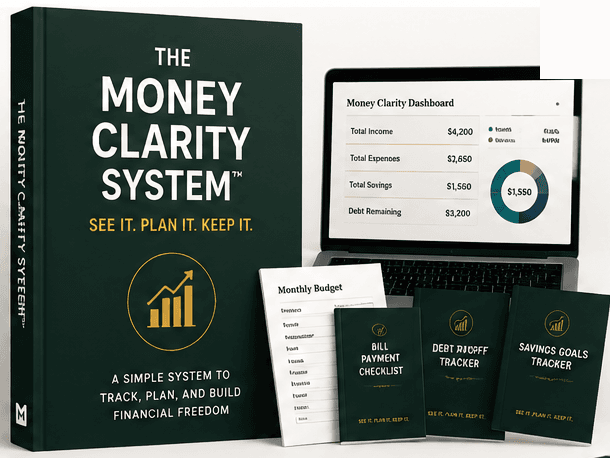
The Money Clarity System™
Ready to actually track it, not just read about it?
The full guide, dashboard, planner, challenges, and bonuses — one payment, lifetime access.
Related articles

Money Management
How to Organize Your Personal Finances (A Complete System)
Disorganized finances aren't usually about the amount of money involved — they're about information (bills, accounts, documents) scattered with no single system holding it together.
3 min read

Expense Tracking
How to Track Recurring Expenses (Before They Add Up Unnoticed)
Recurring charges are uniquely easy to lose track of, because they don't require a new decision each time. A dedicated system catches what a general review often misses.
3 min read

Financial Goals
The Weekly Money Check-In: A Short Habit That Prevents Big Problems
A weekly money check-in catches an overspending category or a stalled goal while there's still time to adjust — a monthly-only review usually catches it too late.
3 min read