Money Management
How to Organize Your Personal Finances (A Complete System)

Disorganized personal finances usually aren't about the amount of money involved — they're about information scattered across too many places with no single system holding it together: bills in different apps, accounts with unclear purposes, documents that can't be found when actually needed. Organizing personal finances is largely about building that missing system.
Step 1: Take a Full Inventory
Before organizing anything, list everything that exists: every bank account, every credit card, every loan, every subscription, every recurring bill. This step alone often surfaces something forgotten — an old account, a subscription still charging, a bill paid inconsistently because it wasn't clearly tracked anywhere.
Step 2: Give Every Account a Clear Purpose
Rather than accounts existing just because they were opened at some point, assign each one a specific, current purpose: everyday spending, emergency savings, a specific goal. An account with no clear purpose tends to create confusion — money sitting in it without a defined role, unclear whether it's available to spend or meant to stay untouched.
Closing or consolidating accounts that no longer serve a clear purpose, where practical, reduces the overall complexity of the system.
Step 3: Centralize Bill Due Dates
Bills scattered across different apps, emails, and paper statements are easy to lose track of. Bringing every due date into one place — a calendar, a spreadsheet, a dedicated app — removes the risk of a missed payment simply from not seeing it in time, separate from the question of whether the money to pay it exists.
Step 4: Automate What Can Be Automated
Recurring bills with a stable amount are strong candidates for autopay, removing them from the list of things that need active, month-to-month attention. Bills with variable amounts can still benefit from automated reminders, even if the payment itself isn't automated.
Step 5: Build a Simple Document System
Tax documents, account statements, insurance policies, and similar records are useful to have organized and findable rather than scattered. This doesn't need to be elaborate — a consistent folder structure, digital or physical, that's actually maintained is more valuable than an elaborate system that's too complicated to keep up with.
Step 6: Connect the Organized Pieces to the Budget and Tracking System
Organization on its own doesn't replace budgeting or expense tracking — it supports them. A clear inventory of accounts and bills makes building a budget and tracking expenses meaningfully easier, since the underlying information is already centralized rather than needing to be gathered from scratch each time.
Step 7: Set a Regular Review to Keep It Current
An organized system decays over time without maintenance — a new subscription gets added, an account changes purpose, a bill's due date shifts. A light monthly check, alongside a regular financial checkup, and a more thorough annual review catches this drift before the system becomes disorganized again.
What Disorganization Actually Costs
Beyond the stress of not having a clear picture, disorganized finances have real practical costs: missed payments from a bill that wasn't tracked anywhere, forgotten subscriptions still charging, difficulty making informed decisions because the full picture isn't visible in one place. Organization doesn't directly create more money, but it removes friction and risk that otherwise compound quietly over time.
Building the System This Month
Start with the full inventory — it's the step everything else depends on — then assign purposes to accounts, centralize bill dates, automate what can be automated, and set a recurring review. None of these steps is individually complicated; the value comes from having all of them in place together, consistently maintained.
Want your accounts, bills, and budget already brought together in one dashboard? MoneyMap is built to centralize exactly this.
Frequently asked questions
What's the first step in organizing personal finances?
A full inventory — every account, bill, and debt in one place. Without this, it's hard to know what actually needs organizing, since some accounts or bills tend to be forgotten until this step surfaces them.
How many bank accounts are reasonable to have?
There's no fixed number, but each account should have a clear purpose — everyday spending, emergency savings, a specific goal. Accounts with no clear purpose tend to create confusion rather than useful separation.
Should financial documents be organized digitally or on paper?
Either works, as long as it's consistent and searchable. A digital system is often easier to search and back up; a paper system works fine if it's actually maintained with the same discipline.
How often should the whole system be reviewed?
A light check monthly, alongside a regular financial checkup, and a more thorough review annually to catch anything that's drifted out of date, like an old account or an outdated beneficiary.
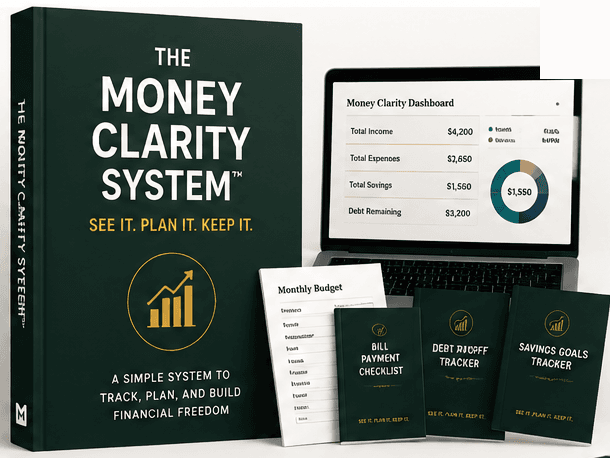
The Money Clarity System™
Ready to actually track it, not just read about it?
The full guide, dashboard, planner, challenges, and bonuses — one payment, lifetime access.
Related articles

Money Management
How to Take Control of Your Money When It Feels Overwhelming
"Take control of your money" sounds like it requires a dramatic overhaul. In practice, it's a specific, ordered set of small steps — most of them about visibility, not willpower.
4 min read

Money Management
How to Create a Personal Financial Plan From Scratch
A financial plan isn't a single document — it's a budget, a savings structure, and a debt plan, connected to each other instead of managed as separate, disconnected pieces.
3 min read

Debt Management
How to Organize Multiple Debts Into One Clear Plan
Debt spread across several cards, loans, and accounts is hard to make decisions about until it's all in one place. Organizing it is a distinct first step, before any payoff strategy.
3 min read

Financial Goals
How to Create a Personal Money Dashboard (One Place for Everything)
Checking a budget in one app, savings in another, and debt in a third makes it hard to see the whole picture at once. A single dashboard view solves that directly.
3 min read