Money Management
How to Take Control of Your Money When It Feels Overwhelming

"Take control of your money" sounds like it requires some dramatic overhaul — a complete lifestyle change, a strict new set of rules. In practice, the process is smaller and more specific than that, and it starts with something less dramatic than most people expect: visibility.
Why Finances Feel Overwhelming in the First Place
A lot of the feeling of being financially out of control comes from uncertainty, not from the actual numbers being unmanageable. Not knowing exactly how much debt exists, not knowing where money is really going, not having a clear sense of whether this month is fine or a problem — that uncertainty itself creates stress, often more than the underlying numbers would if they were actually known clearly.
This is why the first real step isn't a dramatic financial change. It's replacing uncertainty with a clear, honest picture.
Step 1: See the Real Numbers, All of Them
List actual income, every expense, and every debt — completely, without judgment or immediate action. The goal at this stage is visibility, not fixing anything yet. This step alone often reduces the feeling of being overwhelmed, even before any actual financial outcome has changed, simply because a known, specific number is easier to face than a vague, uncertain one.
Step 2: Separate What's Urgent From What's Important
Not everything in a financial picture needs immediate action. Distinguish between things that are urgent (a payment due soon, an account close to overdraft) and things that are important but not time-sensitive (building an emergency fund, a longer-term debt payoff plan). Tackling the urgent items first prevents new problems while the more important, longer-term work gets underway.
Step 3: Build One Small System at a Time
Rather than trying to overhaul budgeting, saving, and debt payoff simultaneously, build one system at a time — a basic budget first, then expense tracking, then a specific savings or debt plan. Personal Finance for Beginners covers a reasonable order for this sequence in more depth.
Attempting everything at once tends to produce a level of change that's hard to sustain; building one piece at a time produces something that actually lasts.
Step 4: Automate What Can Be Automated
Bill payments, savings contributions, extra debt payments — anything that can run automatically removes it from the list of decisions that have to be made and remembered every month. This reduces the ongoing mental load significantly, which is often a large part of what makes managing money feel effortful in the first place.
Step 5: Set a Regular, Brief Check-In
A short, consistent time — weekly or monthly — to review the numbers keeps the system from quietly drifting back into the same uncertainty that caused the overwhelmed feeling originally. This doesn't need to be long; ten to fifteen minutes, done consistently, is more effective than an occasional multi-hour deep dive.
Step 6: Expect Progress to Feel Slow at First
Financial control, once built, tends to compound — a working budget makes expense tracking easier, which makes debt payoff and savings goals easier to plan accurately. But in the first few weeks, progress can feel slow, since a lot of the early work is visibility and setup rather than visible financial results. This is normal, not a sign the approach isn't working.
What Doesn't Actually Help
Trying to fix everything simultaneously. This tends to produce short bursts of intense effort followed by burnout, rather than sustained change.
Avoiding the numbers because they might be uncomfortable. Uncertainty is usually more stressful over time than a known, even difficult, number.
Comparing progress to an idealized version of "having it together." Financial control is a process with a real starting point, not a binary state some people have and others don't.
Where This Leads
Taking control of finances isn't one action — it's a sequence: visibility first, then triage, then building systems one at a time, then automation and a regular check-in. Each step makes the next one easier, and the felt sense of being in control tends to show up earlier in this process than the full financial outcome does.
Want a single dashboard that gives you that visibility without piecing together several tools? MoneyMap is built to bring budgeting, tracking, and goals into one place.
Frequently asked questions
What's the first step when finances feel completely out of control?
Getting a clear, honest picture of the actual numbers — income, expenses, and debt — before making any changes. Feeling out of control usually comes from not knowing the real numbers, not from the numbers themselves being unmanageable.
Is it necessary to make big changes right away?
No — starting with visibility (seeing the real numbers) before making changes tends to produce better, more sustainable decisions than immediate, dramatic cuts made without a clear picture first.
How long does it take to feel back in control of finances?
The feeling of control often improves within the first few weeks, once real visibility exists — even before any major financial outcome has changed, simply because uncertainty is a big part of what makes finances feel overwhelming.
What if the real numbers turn out to be worse than expected?
That's still more useful than not knowing — an accurate picture, even an uncomfortable one, allows for a real plan. Vague anxiety about unknown numbers is harder to act on than a specific, known problem.
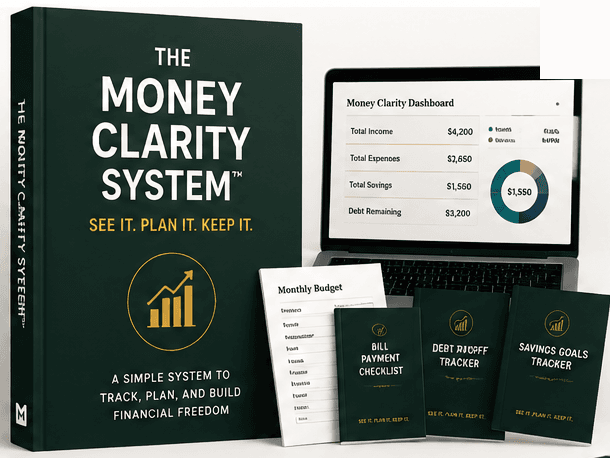
The Money Clarity System™
Ready to actually track it, not just read about it?
The full guide, dashboard, planner, challenges, and bonuses — one payment, lifetime access.
Related articles

Money Management
Personal Finance for Beginners: Where to Actually Start
Personal finance advice usually arrives as an unordered pile: budget, save, invest, pay off debt, build credit. Here's the order that actually makes sense to tackle it in.
4 min read

Money Management
How to Manage Money Better: The Habits That Actually Matter
People who manage money well aren't usually following a complicated system. They're consistently doing a handful of specific, unglamorous things.
3 min read

Money Management
How to Organize Your Personal Finances (A Complete System)
Disorganized finances aren't usually about the amount of money involved — they're about information (bills, accounts, documents) scattered with no single system holding it together.
3 min read

Money Management
The Monthly Financial Checkup: A Simple Recurring Routine
A monthly financial checkup is broader than a spending review — it's a short routine that checks the whole picture: budget, savings, debt, and goals together.
3 min read