Money Management
How to Manage Money Better: The Habits That Actually Matter

People who manage money well aren't usually following an elaborate system or exercising extraordinary discipline. In most cases, they're consistently doing a small set of specific, fairly unglamorous things — and the consistency matters more than any individual habit's sophistication.
Know the Real Numbers
Real take-home income, real fixed expenses, real average variable spending. This sounds basic, but a meaningful share of financial stress and poor decisions trace back to not actually knowing these numbers precisely — operating on a rough sense rather than a verified one.
Automate What Doesn't Need a Decision Every Time
Bill payments, savings contributions, extra debt payments — automating these removes them from the list of things that have to be actively remembered and decided each month. This isn't about avoiding engagement with money; it's about reserving active decision-making for the things that actually benefit from it, rather than spending that attention on routine, repetitive tasks.
Track Spending Consistently, Not Perfectly
A consistent, if imperfect, tracking habit reveals far more useful information than an attempt at perfect tracking that gets abandoned after two weeks. How to Track Your Expenses covers building a sustainable version of this habit.
Review Regularly, Even Briefly
A short, regular check-in — weekly for spending, monthly for the bigger picture — is one of the least exciting-sounding habits on this list and one of the most impactful. It's what catches a category drifting or a goal falling behind while the fix is still small, rather than after it's compounded into a bigger problem.
Separate Money by Purpose
Keeping emergency savings, specific goal savings, and everyday spending money clearly separated — even through simple account labels — makes it much easier to know what's actually available for a given purpose at any moment, rather than working from one blended, ambiguous total.
Make Big Financial Decisions Deliberately, Not Reactively
Large purchases, taking on new debt, or big changes to spending patterns tend to go better when made with a specific plan behind them, rather than reactively in the moment. A short pause — even a day or two — before a major financial decision, checking it against the actual budget and current goals, tends to produce better outcomes than immediate action.
Revisit the Whole Picture Periodically
Circumstances change — income, expenses, goals, priorities. A periodic, broader review (beyond the regular weekly or monthly check-ins) — Monthly Financial Checkup covers this — keeps the overall plan matched to current reality instead of running on assumptions from months or years ago.
Build One Habit at a Time
Trying to adopt every one of these habits simultaneously tends to be less effective than building them one at a time, letting each one become routine before adding the next. Tracking becomes much easier once a basic budget already exists; automation becomes more meaningful once real numbers and categories are already established.
Why Discipline Matters Less Than It Seems
A common assumption is that people who manage money well simply have more willpower. In practice, good systems reduce how much willpower is actually required — automation removes the need to remember, clear categories remove the need to decide from scratch each time, and regular reviews catch problems early rather than requiring heroic effort to fix later. The habits do the work that discipline alone struggles to sustain long-term.
What This Looks Like Over Time
None of these habits produce a dramatic result immediately. Their value compounds — accurate numbers make tracking easier, tracking makes reviews more useful, reviews make goals more achievable. A few months of consistency across a handful of specific habits tends to produce a noticeably different financial picture than the same few months without them.
Want a system that already handles the tracking and review side of this, so the habit is easier to maintain? MoneyMap is built around exactly these habits — automatic calculations, clear categories, and an easy weekly check-in.
Frequently asked questions
Is managing money well mostly about discipline?
Less than it seems — good systems (automation, tracking, clear categories) reduce how much discipline is actually required, since fewer decisions have to be made and remembered in the moment.
What's one habit that makes the biggest difference?
A regular review — weekly for spending, monthly for the bigger picture. It's less exciting than budgeting techniques or savings tips, but it's what catches small problems before they compound into larger ones.
Do people who manage money well never overspend?
No — the difference isn't perfection, it's that a specific system catches overspending quickly and adjusts, rather than letting it go unnoticed for months.
How long does it take to build better money management habits?
The habits themselves can start immediately, but they tend to compound — each one makes the next easier — so the full benefit becomes more apparent after a few consistent months, not immediately.
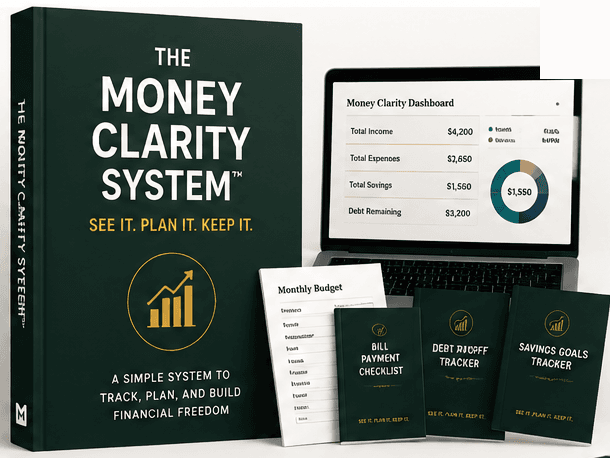
The Money Clarity System™
Ready to actually track it, not just read about it?
The full guide, dashboard, planner, challenges, and bonuses — one payment, lifetime access.
Related articles

Money Management
How to Build Better Money Habits That Actually Stick
Money habits fail for the same reasons any habit fails — too ambitious, too dependent on willpower, no way to see progress. The fix isn't more motivation, it's better structure.
3 min read

Money Management
How to Take Control of Your Money When It Feels Overwhelming
"Take control of your money" sounds like it requires a dramatic overhaul. In practice, it's a specific, ordered set of small steps — most of them about visibility, not willpower.
4 min read

Money Management
How to Create a Personal Financial Plan From Scratch
A financial plan isn't a single document — it's a budget, a savings structure, and a debt plan, connected to each other instead of managed as separate, disconnected pieces.
3 min read

Money Management
The Monthly Financial Checkup: A Simple Recurring Routine
A monthly financial checkup is broader than a spending review — it's a short routine that checks the whole picture: budget, savings, debt, and goals together.
3 min read