Money Management
Personal Finance for Beginners: Where to Actually Start

Personal finance advice tends to arrive as an unordered pile: budget, save, pay off debt, build credit, start investing, plan for retirement — all presented as equally urgent, all at once. For someone just starting out, that pile is more overwhelming than useful. There's an order that actually makes practical sense, and most of it comes down to getting the fundamentals solid before adding complexity.
Step 1: Know the Real Numbers
Before budgeting, saving, or paying off anything, get an honest picture of two numbers: actual take-home income, and actual monthly spending. Not estimated spending — actual spending, pulled from a bank or card statement for the last month or two.
Most people are wrong about their own spending in at least one category, and the gap is usually bigger than expected. This step feels unglamorous compared to "starting to invest" or "building credit," but every later step depends on these two numbers being accurate.
Step 2: Build a Basic Budget
With real income and spending numbers in hand, build a simple budget: fixed expenses, variable spending categories based on actual patterns, and whatever's left over. It doesn't need to be sophisticated at this stage — a step-by-step process covers this in more depth, but the goal here is just a working first draft, not a perfect one.
A budget at this stage isn't about restriction. It's about visibility — knowing, before the month starts, roughly where the money is going to go.
Step 3: Build a Small Emergency Fund
Before aggressively paying off debt or building larger savings, get $500 to $1,000 set aside in a separate account. This isn't the full "three to six months of expenses" target — it's a smaller, faster first goal that prevents a single unplanned expense from immediately becoming new debt.
Skipping this step is one of the most common reasons debt payoff plans stall: the first car repair or medical bill with zero savings goes straight onto a card, undoing progress that had already been made.
Step 4: Pay Down High-Interest Debt
With a basic budget and a small cushion in place, direct extra money toward debt — particularly high-interest debt like credit cards, where the interest cost compounds the problem every month it isn't paid down.
There isn't one universally correct payoff order; Debt Snowball vs Debt Avalanche covers the two most common approaches. What matters most at this stage is that a specific, consistent extra amount is going toward debt every month, not which specific ordering method is used.
Step 5: Build Savings Further
Once high-interest debt is under control, grow the emergency fund toward a more complete target — one to three months of essential expenses, eventually more — and start setting aside money for specific goals beyond just emergencies: a car, a move, a larger purchase.
This is also a reasonable point to start thinking about retirement savings if it hasn't started already, particularly if an employer offers any kind of matching contribution — that match is effectively money left on the table if it isn't used.
Step 6: Build the Habit of Reviewing Regularly
None of the previous steps are one-time tasks. Income changes, expenses shift, new goals appear. A short, regular review — weekly for spending, monthly for the bigger picture — keeps the whole system accurate instead of slowly drifting out of sync with real life.
This is the step that separates people who "did personal finance once" from people who actually stay on top of their money long-term. The specific numbers matter less than the habit of checking them.
What Beginners Tend to Get Wrong
Trying to optimize everything at once. Researching the ideal investment account while there's no working budget yet, or high-interest debt still growing, is solving a later-stage problem before the foundational one is handled.
Skipping the emergency fund to pay off debt faster. This feels efficient but often backfires — the first unplanned expense with no cushion adds new debt right back onto whatever was just paid down.
Waiting for the "right time" to start. There's rarely a perfect moment to start budgeting or saving. Starting with real, if imperfect, numbers now beats waiting for an ideal starting point that may not arrive.
Treating a single bad month as proof the system doesn't work. A budget or a debt payoff plan is adjusted over time, not thrown out the first time real life doesn't match the plan exactly.
The Order, Summarized
Know the real numbers, build a basic budget, get a small emergency cushion, pay down high-interest debt, build savings further, and review regularly. Each step makes the next one more effective — skipping ahead to a later step without the earlier ones in place tends to be where personal finance plans quietly fall apart.
Want a system that walks through this whole sequence — budget, savings tracker, debt payoff plan — instead of piecing it together from scratch? MoneyMap is built to cover exactly this foundation in one place.
Frequently asked questions
What's the very first thing to do in personal finance?
Get a clear, honest picture of income and spending before doing anything else. Every other step — budgeting, saving, debt payoff — depends on knowing these two numbers accurately.
Should a beginner focus on saving or paying off debt first?
A small emergency fund first — around $500 to $1,000 — then debt payoff, then building savings further. Skipping the small emergency fund tends to mean new debt gets added on top of old debt the first time something unplanned comes up.
Do I need to understand investing to get started with personal finance?
No — investing is worth learning eventually, but it's not where personal finance starts. A stable budget, an emergency fund, and manageable debt come first; investing works better once those are in place.
How long does it take to feel like personal finance is 'handled'?
Longer than most guides imply, and that's normal. A working budget can exist within weeks, but building real savings and paying down real debt takes months to years, depending on where someone starts.
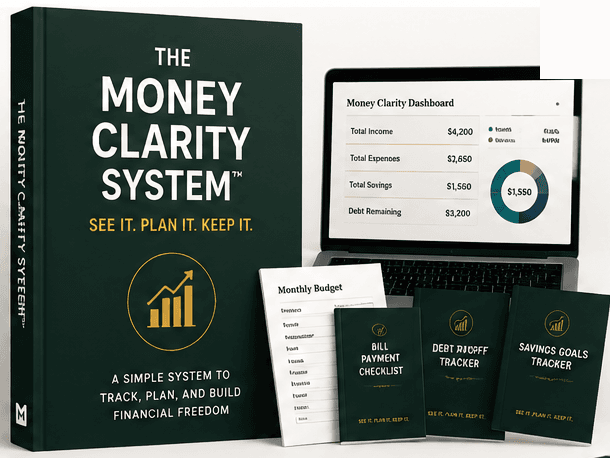
The Money Clarity System™
Ready to actually track it, not just read about it?
The full guide, dashboard, planner, challenges, and bonuses — one payment, lifetime access.
Related articles

Budgeting
How to Create a Monthly Budget (That Fits Your Actual Paycheck)
A monthly budget only works if it matches how income actually arrives — not a single averaged total that ignores the timing of real paychecks and real bills.
4 min read

Saving Money
How to Build an Emergency Fund (Even If You're Starting From Zero)
An emergency fund doesn't need to reach 'six months of expenses' to start protecting you. The gap between zero and a few hundred dollars matters more than most advice admits.
5 min read

Money Management
How to Take Control of Your Money When It Feels Overwhelming
"Take control of your money" sounds like it requires a dramatic overhaul. In practice, it's a specific, ordered set of small steps — most of them about visibility, not willpower.
4 min read

Financial Goals
How to Set Financial Goals You'll Actually Follow Through On
"Save more money" isn't a goal — it's a direction. A goal has a number, a deadline, and a specific plan for getting there. Here's how to build one that actually works.
5 min read