Debt Management
How to Pay Off Credit Card Debt (A Realistic Plan)

Credit card debt is expensive in a specific way that makes it different from most other debt: the interest compounds on a balance that can keep growing if new charges are added faster than the old balance is paid down. A payoff plan that doesn't account for that dynamic tends to underperform, even when the person following it is making real payments every month.
Understand Why the Balance Moves So Slowly on Minimums
Minimum payments on a credit card are typically calculated as a small percentage of the balance, often barely more than the interest charged that billing cycle. That means a large share of every minimum payment goes toward interest, and only a small share actually reduces the principal balance.
This is why credit card debt can feel like it's barely moving even with consistent minimum payments — because, mathematically, it mostly isn't. Any amount paid beyond the minimum goes almost entirely toward principal, which is why extra payments have an outsized effect on payoff speed compared to what their dollar amount might suggest.
Step 1: Stop Adding to the Balance
This is the step that makes every other step work. Continuing to charge new purchases to a card that's also being paid down means new interest-accruing balance is added at the same time old balance is being paid off — a mathematical tug-of-war that can leave the total balance roughly flat for months even with real payments happening.
For most people working through significant credit card debt, this means using debit, cash, or a separate card reserved only for planned, budgeted spending — not the card carrying the balance — until that balance is meaningfully down or fully paid off.
Step 2: Know the Exact Numbers
For every card involved: current balance, interest rate (APR), and minimum payment. This takes ten minutes and changes the entire plan — a card at 24% APR needs to be prioritized very differently from one at 14% APR, even if the balances are similar.
Step 3: Find Real Extra Payment Room in the Budget
Look at actual spending — not an idealized version of it — for categories that can be temporarily reduced. This doesn't need to be permanent or extreme; even a modest, sustainable amount redirected consistently toward debt compounds meaningfully over months, given how much of a minimum payment is otherwise absorbed by interest.
Step 4: Choose a Payoff Order and Stick With It
With multiple cards, extra payments work best concentrated on one card at a time rather than split evenly across all of them. Two common approaches:
Highest interest rate first (the "avalanche" method) minimizes total interest paid — pay minimums on every card except the one with the highest rate, and put all extra payments there until it's gone, then move to the next-highest rate.
Smallest balance first (the "snowball" method) builds momentum through early wins — pay off the smallest balance completely first regardless of its rate, then roll that payment amount onto the next-smallest balance.
Debt Snowball vs Debt Avalanche goes deeper into choosing between the two. Either approach beats splitting extra payments evenly, which spreads the impact thin across every card instead of concentrating it where it moves a balance to zero fastest.
Step 5: Consider a Balance Transfer, With a Real Plan Behind It
A balance transfer to a lower-interest or promotional 0% card can meaningfully reduce interest costs — but only if there's an actual plan to pay down the balance before a promotional rate expires, and if the transfer fee (commonly 3-5% of the balance) is smaller than the interest that would otherwise accrue.
A transfer without a payoff plan behind it just moves the same balance to a new card, often with a new deadline attached, without addressing the underlying gap between spending and payoff progress.
Step 6: Automate the Extra Payment
Treat the extra payment the same way a fixed bill gets treated — scheduled automatically, right after income arrives, rather than left as "whatever's available" at the end of the month. Money left as leftover has a way of not existing by the time it would be applied to debt.
What Actually Slows Payoff Down
Making only minimum payments. Given how much of a minimum goes to interest, minimum-only payments can take years to clear even a moderate balance, and pay significantly more in total interest than a plan with any consistent extra payment.
Continuing to use the card being paid down. New charges undo progress in real time, even when payments are being made consistently.
Splitting extra payments across every card evenly. This feels fair but is mathematically slower than concentrating extra payments on one card at a time.
Treating a balance transfer as a solution by itself. Without a real payoff plan, a transfer just relocates the balance and resets the clock.
What a Realistic Timeline Looks Like
Payoff speed depends heavily on the gap between total minimum payments and what's actually available to pay each month. A plan with a meaningful, consistent extra payment amount — even a modest one — typically clears a moderate credit card balance in a matter of months to a couple of years, compared to a much longer timeline on minimums alone. The exact number depends on the specific balances and rates involved, which is why step 2 — knowing the real numbers — matters before setting expectations either way.
Want to see your actual payoff timeline based on your real balances and rates, side by side under different payment amounts? MoneyMap includes a debt payoff planner built to model exactly this.
Frequently asked questions
Should I stop using the card completely while paying it off?
For most people, yes, at least until the balance is meaningfully down. Continuing to charge new purchases while trying to pay off an existing balance usually cancels out progress, since new charges accrue interest just as the old balance does.
Is it worth transferring a balance to a lower-interest card?
It can be, if the transfer fee is smaller than the interest that would be saved, and if there's a real plan to pay off the balance before any promotional rate expires. A balance transfer without a payoff plan behind it often just moves the same problem to a new card.
Should I pay more than the minimum every month?
Whenever possible, yes. Minimum payments are calculated to be barely more than the interest charged that month, meaning the actual balance moves down very slowly on minimums alone — often taking years longer than a plan with any extra payment included.
What if I have multiple credit cards with different balances?
Pick one clear ordering method — highest interest rate first, or smallest balance first — and put extra payments toward one card at a time while paying minimums on the rest. Splitting extra payments evenly across every card slows down payoff compared to concentrating it.
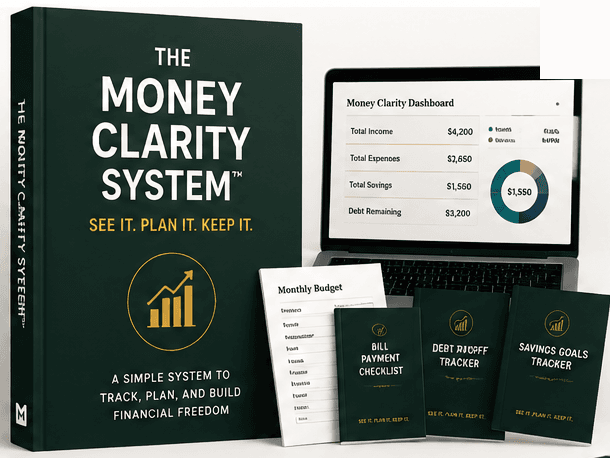
The Money Clarity System™
Ready to actually track it, not just read about it?
The full guide, dashboard, planner, challenges, and bonuses — one payment, lifetime access.
Related articles
Debt Management
Debt Snowball vs Debt Avalanche: Which One Pays Off Debt Faster?
Both methods pay off the same debt eventually. They differ in what keeps a person actually going — and that difference matters more than the math suggests.
4 min read

Debt Management
How to Create a Debt Payoff Plan (With a Real Timeline)
A list of debts isn't a plan. A plan has an order, a monthly number, and a realistic date attached — here's how to build one from scratch.
3 min read

Debt Management
How to Organize Multiple Debts Into One Clear Plan
Debt spread across several cards, loans, and accounts is hard to make decisions about until it's all in one place. Organizing it is a distinct first step, before any payoff strategy.
3 min read

Debt Management
How to Stop Living Paycheck to Paycheck
The paycheck-to-paycheck cycle isn't usually about how much someone earns — it's about a structural gap that keeps pulling every paycheck to zero before the next one arrives.
5 min read