Expense Tracking
Why Expense Tracking Matters (Even If Your Budget Seems Fine)

"I don't really need to track my spending — I know roughly where my money goes" is a common belief, and real tracking data consistently contradicts it in specific, predictable ways. Not because people are careless, but because intuition is genuinely bad at estimating certain kinds of spending, no matter how attentive someone tries to be.
Intuition Consistently Misses Certain Categories
Small, frequent purchases — a coffee, a quick food stop, a small online purchase — don't register the same way a single large expense does. Each one feels insignificant in the moment, so none of them get remembered individually, and the running total across a month goes unnoticed until it's actually calculated.
Recurring charges have a similar blind spot for a different reason: they don't require an active decision each time, so they stop feeling like "real" ongoing spending even though they continue billing every month. Why Recurring Expenses Are Easy to Miss covers this specific pattern in more depth.
Tracking Reveals Patterns, Not Just Totals
A single total spending number for the month is useful, but it doesn't say much about why. Tracked, categorized data reveals patterns — a category that's crept up gradually over several months, a specific trigger that consistently leads to extra spending, a time of month when spending reliably spikes. These patterns are invisible without ongoing tracking, because they only become visible when data is compared across time, not judged in any single moment.
Tracking Validates Decisions, Not Just Flags Problems
Tracking isn't only useful for finding overspending — it also confirms when spending in a category is genuinely reasonable and worth continuing without guilt. Without real data, it's easy to feel vaguely uncertain about every expense; with real data, a category that's actually fine can be confirmed as fine, freeing up mental energy to focus on the categories that actually need attention.
Tracking Catches Drift Before It Becomes a Real Problem
A budget that felt accurate a few months ago can quietly drift out of sync with real spending — a category that's crept up gradually, a new recurring charge, a change in habits that happened without a deliberate decision. Without tracking, this drift is usually only noticed once it's become significant — a low bank balance, a missed goal. With regular tracking, the same drift shows up early, while it's still a small, easy adjustment.
Tracking Turns Financial Goals Into Something Measurable
A savings or debt payoff goal without tracking behind it relies on hope that the necessary amount is actually being set aside each month. With tracking, progress toward that goal is a real, checkable number — not an assumption. How to Set Financial Goals covers building goals with this kind of measurable structure from the start.
What Happens Without Any Tracking
Spending decisions get made based on a general feeling rather than real numbers — a feeling that's consistently optimistic about small and recurring expenses, and slow to catch gradual drift in any single category. Budgets built without tracking behind them are really just untested guesses, no matter how carefully they were originally planned.
Why "I Already Know Where My Money Goes" Rarely Holds Up
Even people who consider themselves financially attentive are frequently surprised by at least one category once they actually track for a month — usually the small, frequent purchases or the recurring charges that don't register as "real" spending in the moment. This isn't a character flaw; it's simply how attention and memory work, and it's exactly the gap that tracking is built to close.
Getting Started, Even Briefly
A single, honestly tracked month — every transaction categorized, no guessing — is often enough to reveal at least one real, useful insight that intuition had missed. How to Track Your Expenses covers building this into an ongoing habit rather than a one-time experiment.
Want your spending patterns visible automatically instead of manually reviewing statements to check your assumptions? MoneyMap includes a dashboard built to make this visibility effortless.
Frequently asked questions
Is expense tracking necessary if a budget already feels like it's working?
It's still valuable even then — tracking is what confirms a budget is actually working versus just feeling fine, and it's the only reliable way to catch a category quietly drifting before it becomes a real problem.
Can intuition alone replace expense tracking?
Not reliably. Intuition consistently underestimates small, frequent purchases and overlooks recurring charges that have become automatic — gaps that only show up once real data is reviewed.
Does expense tracking help beyond just cutting spending?
Yes — it also validates spending that's genuinely worth it, confirms progress toward savings and debt goals with real numbers, and makes financial decisions based on facts instead of a general feeling.
How long does someone need to track before it becomes useful?
Even a single well-tracked month reveals real patterns; two to three months gives a more reliable picture, since it smooths out one-off expenses and confirms what repeats consistently.
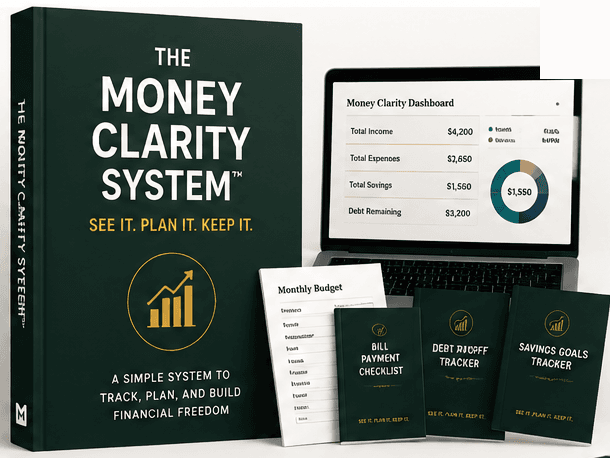
The Money Clarity System™
Ready to actually track it, not just read about it?
The full guide, dashboard, planner, challenges, and bonuses — one payment, lifetime access.
Related articles

Expense Tracking
How to Track Your Expenses (And Actually Keep Doing It)
Most expense tracking attempts fail within a few weeks, not because the concept is hard, but because the method chosen was more effort than the person was willing to sustain.
3 min read

Expense Tracking
Where Is My Money Going? How to Actually Find Out
"I don't know where my money goes" is usually a specific, findable gap — not a mystery. A short transaction review almost always answers the question directly.
3 min read

Expense Tracking
How to Review Your Monthly Spending (A Simple Process)
Tracking spending without reviewing it is only half the process. A short, structured monthly review is what actually turns data into a better plan.
3 min read

Budgeting
How to Budget Your Money Step by Step
Budgeting isn't complicated in theory. It falls apart in the gap between the plan and what actually happens with a paycheck. Here's a process that closes that gap.
6 min read