Expense Tracking
How to Categorize Expenses So Your Budget Actually Makes Sense

Category design is one of the most underrated parts of a budget that actually lasts. Categories that are too broad hide exactly the problems a budget is supposed to reveal. Categories that are too narrow turn logging a purchase into a small chore — exactly the kind of friction that causes people to quietly stop tracking a few weeks in.
Why Category Design Matters More Than It Seems
Two budgets can have identical income and identical total spending, and be wildly different in usefulness, purely based on category structure. A budget with one giant "miscellaneous" category can balance perfectly on paper while hiding a real, fixable spending pattern inside it. A budget with forty hyper-specific categories can capture everything accurately while being so tedious to maintain that it gets abandoned within a month.
The right level of detail isn't a fixed number — it's whatever level lets real patterns show up without making tracking feel like a burden.
Start From Actual Spending, Not a Generic List
The fastest way to end up with categories that don't fit is copying a generic list without checking it against real spending. Templates are built for an average that doesn't describe anyone specifically.
A better starting point: look at two or three months of real transactions and group them by what naturally seems to belong together, based on how the spending actually feels — not an external system's predefined labels. If "coffee on the way to work" and "grocery shopping" don't feel like the same kind of spending, even though both are technically food, they probably shouldn't share a category.
Signs a Category Is Too Broad
A category is too broad when going over budget in it doesn't say anything actionable. "General spending" coming in over budget doesn't point to what changed or what to adjust next month.
Broad categories are especially common around "shopping," "miscellaneous," and "personal" — labels vague enough to absorb almost anything, which means they absorb exactly the spending patterns a budget is supposed to surface.
Signs a Category Is Too Narrow
A category is too narrow when logging into it takes more effort than the insight is worth. Separate categories for "coffee," "tea," and "energy drinks" is more granularity than most people need — one "drinks on the go" category likely captures the same insight for a fraction of the effort.
Over-splitting also creates categories with tiny, inconsistent monthly totals that are hard to set a meaningful limit on in the first place.
A Practical Structure That Works for Most Budgets
While the exact categories should come from a real spending review, a reasonable starting shape usually includes:
- Fixed essentials (rent, utilities, insurance) — predictable, usually one category each
- Variable essentials (groceries, transportation, phone) — necessary but with month-to-month flexibility, worth tracking closely
- Discretionary spending (dining out, entertainment, hobbies) — the group most likely to reveal overspending, worth splitting into a few sub-categories based on actual habits
- Subscriptions — often worth isolating, since individually small charges add up in ways that are easy to lose track of otherwise
- Debt payments — separated from general spending so payoff progress is visible at a glance
- Savings — treated as a category with a required contribution, not whatever's left over
- Buffer / irregular expenses — funded regularly for the predictable-in-aggregate, unpredictable-in-timing costs that otherwise blow up an accurate budget
This is a starting shape to adjust, not a rule to follow exactly.
Revisit Categories Periodically, Not Constantly
Categories that fit well at the start can stop fitting as circumstances change — a new job changes the transportation category, a move changes the housing category. A quick review every few months, more often if things are actively changing, keeps categories accurate.
Avoid the opposite failure too: restructuring categories every few weeks makes it hard to compare spending over time and turns budget maintenance into a bigger task than it needs to be.
The Test That Actually Matters
A good category structure passes a simple test: when a category comes in over or under budget, does that say something specific and actionable? If yes, it's doing its job. If going over budget in a category just produces a shrug, it's either too broad to be useful or tracking something that was never worth separating out.
Want categories that are already built and ready to adjust to your real spending instead of starting from a blank sheet? MoneyMap comes with a full category structure and an auto-calculating dashboard, so the setup work in this article is already done.
Frequently asked questions
Should 'entertainment' and 'dining out' be separate categories?
If they behave differently for you — one is planned, one is impulsive, or one is a much bigger share of spending than the other — separating them gives more useful information. If both are small and similarly behaved, combining them reduces tracking effort without losing much insight.
How many expense categories should a budget have?
Somewhere between 8 and 15 for most people — enough to see real patterns without making every purchase a small decision about which category it belongs in.
Do subscriptions need their own category?
Usually yes, at least at first. Individually small subscription charges are one of the most common blind spots in a budget — a dedicated category makes the real total visible instead of scattering it across other categories.
How often should categories be revisited?
A quick review every few months is usually enough, more often if income or spending patterns are actively changing. A category that no longer reflects real spending should be merged, split, or renamed rather than left inaccurate.
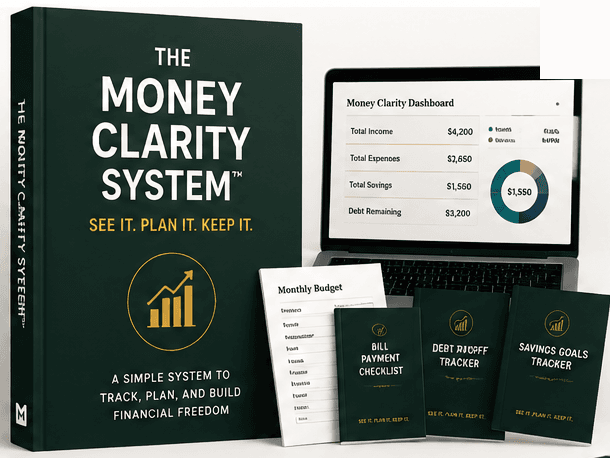
The Money Clarity System™
Ready to actually track it, not just read about it?
The full guide, dashboard, planner, challenges, and bonuses — one payment, lifetime access.
Related articles

Expense Tracking
How to Track Your Expenses (And Actually Keep Doing It)
Most expense tracking attempts fail within a few weeks, not because the concept is hard, but because the method chosen was more effort than the person was willing to sustain.
3 min read

Budgeting
How to Create a Monthly Budget (That Fits Your Actual Paycheck)
A monthly budget only works if it matches how income actually arrives — not a single averaged total that ignores the timing of real paychecks and real bills.
4 min read

Expense Tracking
Where Is My Money Going? How to Actually Find Out
"I don't know where my money goes" is usually a specific, findable gap — not a mystery. A short transaction review almost always answers the question directly.
3 min read

Expense Tracking
How to Find Unnecessary Expenses in Your Budget
Generic advice to "cut unnecessary spending" doesn't say what's actually unnecessary. Here's a more specific way to find it in your own numbers.
3 min read