Money Management
How to Do a Yearly Money Review and Start the New Year With a Plan

A weekly check-in catches a category that's drifting this week. A monthly checkup reviews the current month's overall picture. Neither one, by design, looks back across a full twelve months to ask the bigger questions: Did this year actually move things in the right direction? What patterns showed up repeatedly? What should change going into next year? That's the specific job of a yearly financial review.
Why a Yearly Review Covers Ground the Others Can't
Shorter review cycles are good at catching near-term problems, but they don't naturally surface year-long patterns — a category that crept up gradually over twelve months, a savings goal that stalled for reasons only visible in hindsight, an income change that shifted the whole picture partway through the year. A dedicated yearly review is the one point where those longer patterns actually get looked at directly, rather than being buried in twelve separate monthly snapshots.
Step 1: Gather the Full-Year Numbers
Start with total income, total spending by major category, total saved, and any change in debt balances across the full year. If detailed tracking happened throughout the year, this is mostly compiling. If it didn't, bank and card statements can reconstruct a reasonably accurate picture — not perfect, but enough to work with.
Step 2: Compare Against Last Year, Not Just Against a Goal
Comparing this year's numbers to the previous year — not just to whatever goal was set at the start of the year — reveals actual trends: is spending in a specific category consistently rising? Is the savings rate improving or flat? This year-over-year comparison is something a single month's or week's data literally cannot show, since it requires the longer time horizon.
Step 3: Review Progress on the Year's Goals
Whatever goals were set — savings targets, debt payoff milestones, specific purchases — check actual progress against them honestly. A goal that wasn't reached isn't necessarily a failure; it's information about whether the goal was realistic, whether priorities shifted during the year for good reason, or whether the plan itself needs adjusting for next year. Setting savings goals that are specific and time-bound makes this step much more useful, since there's something concrete to actually measure against.
Step 4: Identify the Year's Recurring Patterns
Beyond the numbers themselves, look for patterns that showed up more than once: a specific month that was consistently tight, a category that ran over more often than not, a habit that helped and one that didn't. These patterns are usually invisible in any single month but become obvious once a full year is reviewed together.
Step 5: Set Direction for the Year Ahead
The review isn't complete until it produces something forward-looking — adjusted category budgets based on what actually happened this year, updated or new goals for the year ahead, and specific changes to address whatever patterns the review revealed. A review that only looks backward, without translating into a concrete plan, tends not to change much going into the following year.
Example: A Simple Yearly Review Checklist
Look back: Total income and spending by category. Total saved and change in debt balances. Progress against this year's specific goals. Any month that stood out as unusually tight or unusually easy, and why.
Look forward: Adjusted budget categories based on what actually happened, not just what was originally planned. One to three specific, measurable goals for the coming year. Any recurring pattern from this year worth addressing directly — a bill due date that consistently causes friction, a category that consistently runs over, a savings contribution that consistently gets skipped.
Including a Simple Net Worth Snapshot
Beyond income and spending, a yearly review is a natural point to add up total assets (savings, investments, home equity if applicable) minus total debts, producing a single net worth figure. This isn't necessary for every review, but tracked year over year, it's one of the clearest single indicators of overall financial direction — a number that can move in a positive direction even during a year that felt financially tight in the moment, or reveal a concerning trend during a year that felt fine day to day.
Turning the Review Into a Plan, Not Just a Resolution
A vague resolution like "save more next year" rarely survives past January, mostly because it isn't specific enough to act on. A yearly review, done properly, produces something much more concrete: an actual adjusted budget, a specific savings target with a timeline, and a short list of specific changes based on real patterns from the past year — closer to an updated plan than a general intention.
Doing This Even Without a Full Year of Clean Data
If this is the first year doing any kind of financial review, or if tracking was inconsistent, that's not a reason to skip it. Even a partial-year or reconstructed review is useful, and it establishes a baseline that makes next year's review easier and more accurate. The goal is starting the habit, not achieving a perfect first attempt.
Making It a Recurring Habit, Not a One-Time Event
The real value of a yearly review compounds over multiple years — the second year's review is more useful than the first because there's a prior year to compare against, and the third is more useful still. Treating it as a fixed, recurring appointment (the same week every year, not "whenever there's time") is what actually makes that multi-year comparison possible, rather than the review happening inconsistently or being skipped entirely in a busy year.
Common Mistakes
Skipping the review because the data isn't perfect. An imperfect review, based on reconstructed statements, is still far more useful than no review at all.
Reviewing only the numbers, not the patterns behind them. The specific totals matter less than understanding what drove them — a category over budget for a one-time reason is different from one that's been over budget every single month.
Ending the review without a concrete plan for next year. A review that stops at "here's what happened" without moving into "here's what changes" tends not to actually change anything going forward.
Comparing only to a goal, not to last year's actual numbers. Both comparisons matter — one shows whether a target was hit, the other shows whether the underlying trend is improving.
The One Review That Sees the Whole Year
A yearly financial review isn't a replacement for shorter, more frequent check-ins — it's the complement to them, covering the one thing weekly and monthly reviews structurally can't: a full twelve-month view of what actually happened and what should change. Done consistently, once a year, it turns "how did this year go?" from a vague feeling into an answer backed by real numbers — and turns "what should change?" into a specific, actionable plan instead of a resolution that fades by February.
For a full Weekly and Monthly Planner plus a Goal-Setting section built to make next year's review even easier, The Money Clarity System includes tools designed to support exactly this kind of ongoing, year-over-year financial planning.
Frequently asked questions
How is a yearly review different from a monthly checkup?
A [monthly financial checkup](/blog/monthly-financial-checkup) reviews the current picture — this month's budget, savings, and debt. A yearly review looks back across the full twelve months for patterns and trends that only become visible over a longer stretch of time, then sets direction for the year ahead.
When is the best time to do a yearly financial review?
Late December or early January is common, since it lines up with a natural planning point for the year ahead — but any consistent time that works, like a birthday month or the start of a fiscal year, is just as valid as long as it happens reliably every year.
What if I didn't track spending closely all year?
A review is still worth doing with whatever data is available — bank and card statements can reconstruct a rough picture even without detailed tracking throughout the year. It won't be as precise, but it's still far more useful than skipping the review because the data isn't perfect.
How long should a yearly review actually take?
For most people, one to two focused hours is enough to cover the full checklist — it doesn't need to be an all-day project, especially if some tracking happened during the year and doesn't need to be reconstructed from scratch.
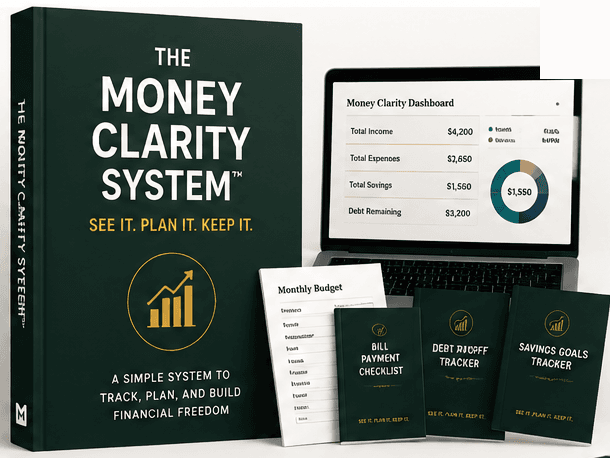
The Money Clarity System™
Ready to actually track it, not just read about it?
The full guide, dashboard, planner, challenges, and bonuses — one payment, lifetime access.
Related articles

Money Management
The Monthly Financial Checkup: A Simple Recurring Routine
A monthly financial checkup is broader than a spending review — it's a short routine that checks the whole picture: budget, savings, debt, and goals together.
3 min read

Financial Goals
The Weekly Money Check-In: A Short Habit That Prevents Big Problems
A weekly money check-in catches an overspending category or a stalled goal while there's still time to adjust — a monthly-only review usually catches it too late.
3 min read

Saving Money
How to Set Savings Goals You'll Actually Reach
A savings goal without a number and a deadline isn't really a goal — it's a hope. The difference between the two is what determines whether it actually gets reached.
4 min read