Saving Money
How to Set Savings Goals You'll Actually Reach

A savings goal without a specific number and a deadline isn't really a goal — it's a hope, and hopes don't come with a way to measure whether progress is actually happening. The difference between "I want to save more" and "I want to save $2,500 in 10 months" is the difference between an intention and something that can actually be planned around.
Why Vague Savings Intentions Don't Work
"Save more this year" gives no way to check, at any point during the year, whether things are on track. There's no monthly number to compare against, no clear signal for whether this month counted as progress — which makes it easy to quietly stop trying without ever consciously deciding to.
A specific goal removes this ambiguity entirely: a target amount, a deadline, and the monthly contribution that connects the two.
The Three Elements of a Real Savings Goal
A specific dollar amount. Not "a lot" or "more than before" — an actual number, chosen deliberately based on what the goal is actually for (a specific purchase, an emergency fund size, a target for a larger goal).
A deadline. Even an approximate one. A goal with no timeline can always be pushed to "eventually," which functions the same as never actually happening.
A monthly contribution figure. Divide the amount by the months until the deadline. This is the number that actually gets acted on each month — everything else is just context for why this number matters.
An Example
Vague: "I want to save up for a trip next year."
Specific: "I want to save $2,400 for a trip in 10 months. That's $240 a month. I'll automate a transfer for that amount right after each paycheck, and check progress against the running total on the first of each month."
The second version can be tracked, adjusted, and actually completed. The first one can't, because there's nothing concrete to measure it against.
Prioritize Instead of Spreading Thin
It's common to want to save toward several things at once — an emergency fund, a specific purchase, a longer-term goal. Splitting a limited monthly savings capacity evenly across all of them usually means slower progress on every single one, compared to focusing available savings on one or two goals at a time while contributing only a minimal amount, if any, to the others.
A reasonable default: a small emergency cushion first, then whichever goal is most time-sensitive or personally motivating next, rather than treating every goal as equally urgent simultaneously.
Separate Short-Term Goals From Long-Term Ones
A goal reachable within a year needs a monthly contribution that's realistic against current income right now. A goal that's genuinely multi-year — a house down payment, a much larger target — has more room to grow alongside income and can tolerate a smaller starting contribution that increases over time. Treating both types of goals with the same monthly-pace expectation tends to make short-term goals feel unrealistic and long-term goals feel unnecessarily rushed.
Revisit the Goal When Circumstances Actually Change
A savings goal built around a specific monthly contribution assumes that contribution stays realistic. When income or expenses change meaningfully, adjusting the deadline or the monthly amount — rather than abandoning the goal outright — keeps it alive and achievable. A goal recalibrated to fit new circumstances is still a goal being worked toward; one dropped at the first obstacle isn't.
What Derails Savings Goals Most Often
No specific number or deadline, leaving no way to measure progress.
Too many goals pursued at equal priority, spreading limited savings capacity too thin to complete any of them meaningfully.
No regular check on progress, letting a goal quietly fall behind for months before anyone notices.
Abandoning the goal at the first sign it needs adjusting, instead of recalibrating the plan and continuing.
Setting a Real Goal Right Now
Pick one goal, assign it a specific number and a deadline, divide by the months available to get a monthly target, and automate a transfer for that amount. How to Build a Savings Plan covers turning this structure into an ongoing system across multiple goals.
Want to track progress toward a real savings goal without a separate spreadsheet? MoneyMap includes a built-in savings tracker that shows exactly how far along you are.
Frequently asked questions
What makes a savings goal specific enough to work?
A dollar amount, a deadline, and a monthly contribution figure derived from dividing the two. Without all three, there's no way to know if a given month is on track or falling behind.
Should savings goals be based on a percentage of income or a fixed amount?
Either can work — a fixed amount is often easier to plan a specific goal around, while a percentage adjusts automatically with income changes. The specific goal (a purchase, an emergency fund size) usually points toward a fixed dollar target regardless.
How many savings goals should be pursued at once?
One or two at a time works best for most budgets. Splitting limited savings capacity across several goals simultaneously tends to slow progress on all of them rather than completing any one goal meaningfully faster.
What if a savings goal's deadline turns out to be unrealistic?
Adjust the deadline or the monthly amount rather than abandoning the goal. A goal recalibrated to fit real circumstances is still on track; one dropped at the first sign of difficulty isn't.
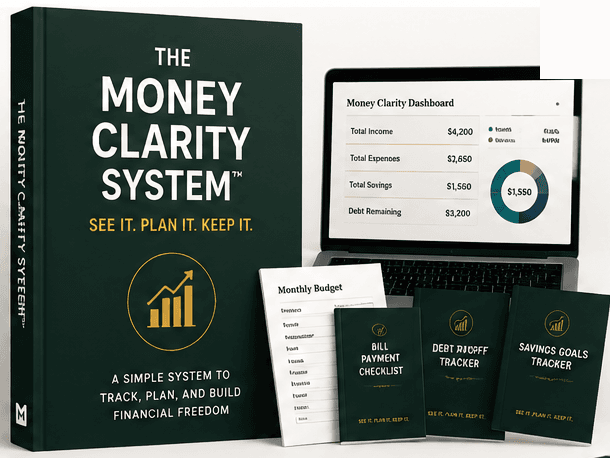
The Money Clarity System™
Ready to actually track it, not just read about it?
The full guide, dashboard, planner, challenges, and bonuses — one payment, lifetime access.
Related articles

Saving Money
How to Build a Savings Plan That Covers Multiple Goals
A single savings account trying to serve several goals at once makes it hard to know how any one of them is actually progressing. A structured plan separates them clearly.
4 min read

Financial Goals
How to Set Financial Goals You'll Actually Follow Through On
"Save more money" isn't a goal — it's a direction. A goal has a number, a deadline, and a specific plan for getting there. Here's how to build one that actually works.
5 min read

Saving Money
How to Track Savings Progress (So It Actually Feels Real)
Money quietly building in an account doesn't feel like progress unless it's actually visible. Tracking is what turns saving from an abstract habit into something motivating.
3 min read

Saving Money
How to Save Your First $1,000
The first $1,000 is disproportionately important — not because of the amount itself, but because it's usually the milestone that makes saving feel real for the first time.
4 min read