Saving Money
How to Save Your First $1,000

The first $1,000 in savings carries more weight than the number alone suggests. It's large enough to cover most common unplanned expenses without reaching for a credit card, and it's usually the point where saving stops feeling like a hypothetical idea and starts feeling like a real, working habit.
Why This Specific Number
$500 to $1,000 covers the majority of common unplanned expenses — a car repair, an urgent medical bill, an appliance replacement — the kind of costs that, without savings, typically end up on a credit card and become new debt on top of whatever else is already being managed.
It's also a genuinely achievable target for most budgets within a matter of months, unlike a full three-to-six-month emergency fund, which can feel too distant to meaningfully motivate action when starting from zero.
Step 1: Open a Separate Account for It
Keeping this money in the same account as everyday spending makes it too easy to absorb into regular purchases without a deliberate decision. A separate savings account — even at the same bank — creates a small but meaningful barrier that keeps the money set aside for its actual purpose.
Step 2: Set a Specific Monthly Amount and Automate It
Divide $1,000 by a realistic number of months — three, six, twelve, whatever fits the budget — to get a specific monthly target, and automate a transfer for that amount right after income arrives. A specific, automated number produces far more consistent progress than an intention to "save when possible."
Step 3: Redirect Windfalls Directly Toward This Goal
Tax refunds, work bonuses, rebates, or any unexpected money are natural, low-friction sources for this specific goal, since they weren't already allocated to regular spending. Applying them directly to the $1,000 target can meaningfully accelerate the timeline without requiring any change to regular monthly spending.
Step 4: Find One or Two Specific, Temporary Cuts
Rather than a vague commitment to spend less broadly, identify one or two specific, temporary reductions — a subscription paused, a recurring order skipped — for the specific period until the goal is reached, with the savings redirected entirely toward it.
Step 5: Track Progress Visibly
Watching the balance climb toward $1,000, even in small increments, reinforces the habit far more than an abstract sense that saving is happening somewhere. A simple running total, checked weekly or monthly, keeps the goal tangible.
Should Debt Payoff Wait Until After This Goal?
For most situations, no — building this first $1,000 cushion before aggressively paying down debt is the more resilient order. Without it, the first unplanned expense after starting a debt payoff plan often goes straight onto a card, adding new debt on top of what's already being paid down and undoing real progress. Personal Finance for Beginners covers this sequencing in more depth.
What Happens After Reaching $1,000
This first milestone isn't the finish line — it's a foundation. From here, the same saved habit typically continues toward either a fuller emergency fund (one to three months of expenses, and beyond) or gets redirected toward high-interest debt payoff, now with a cushion in place to prevent new debt from an unplanned expense along the way.
Common Obstacles Along the Way
Dipping into the fund for non-emergencies. Being clear in advance about what counts as an actual emergency — unplanned, necessary, urgent — versus a planned expense that simply wasn't budgeted for, helps protect the fund's purpose.
Losing momentum without visible progress. A savings goal with no way to track it in view tends to lose priority against more immediate spending pressures.
Treating the goal as too small to matter. $1,000 can feel modest compared to bigger financial goals, but its structural role — preventing new debt from a single unplanned expense — matters disproportionately to its size.
Getting Started
Open the account, set the monthly number, automate the transfer, and redirect the first windfall that comes along. The first $1,000 is one of the most impactful savings milestones precisely because of what it prevents — not because of the amount itself.
Want to track this specific goal alongside your regular budget without a separate spreadsheet? MoneyMap includes a savings tracker built to show exactly how close you are.
Frequently asked questions
Why is $1,000 specifically a common first savings target?
It's large enough to cover most common unplanned expenses — a car repair, an urgent bill — without a credit card, but small enough to feel achievable within a few months for most budgets, unlike a full emergency fund target.
How long does it realistically take to save $1,000?
It depends heavily on how much can be set aside monthly — anywhere from a couple of months to closer to a year. The specific timeline matters less than having a consistent monthly contribution behind it.
Should debt be paid off before saving the first $1,000?
Many financial plans recommend the reverse order — a small $1,000 cushion first, then aggressive debt payoff — since having zero savings means the next unplanned expense adds new debt right on top of whatever's being paid down.
Where should this first $1,000 be kept?
In a separate savings account, apart from everyday spending money, so it isn't accidentally spent and stays easy enough to access when it's genuinely needed.
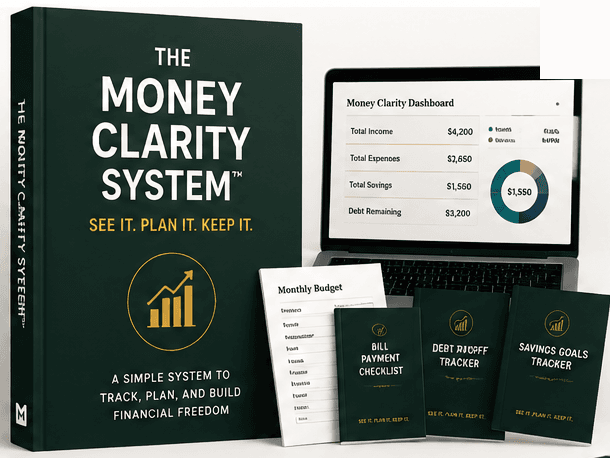
The Money Clarity System™
Ready to actually track it, not just read about it?
The full guide, dashboard, planner, challenges, and bonuses — one payment, lifetime access.
Related articles

Saving Money
How to Build an Emergency Fund (Even If You're Starting From Zero)
An emergency fund doesn't need to reach 'six months of expenses' to start protecting you. The gap between zero and a few hundred dollars matters more than most advice admits.
5 min read

Saving Money
How to Save Money Every Month (Consistently, Not Just Occasionally)
Saving "whatever's left" at the end of the month rarely produces consistent results, because there's rarely much left by the time it's checked. A different structure works better.
3 min read

Saving Money
How to Build a Savings Plan That Covers Multiple Goals
A single savings account trying to serve several goals at once makes it hard to know how any one of them is actually progressing. A structured plan separates them clearly.
4 min read

Saving Money
How to Save Money on a Tight Budget
Generic savings advice assumes room that doesn't exist on a tight budget. A smaller, more deliberate approach works better than trying to force a standard percentage.
4 min read