Saving Money
How to Save Money on a Tight Budget

Most savings advice assumes a level of budget flexibility that doesn't exist for everyone. On a genuinely tight budget, saving still matters — arguably more, since there's less room to absorb an unplanned expense without it — but the approach needs to look different than the standard advice built for a looser budget.
Adjust the Target Size First
Standard advice often points toward saving 15-20% of income or building three to six months of expenses. On a tight budget, these targets can feel so far out of reach that they discourage starting at all. A smaller, genuinely achievable first goal — even $100 to $300 — still provides real protection against small unplanned costs, and it's a target that can actually be reached, which matters more at this stage than the size of the number.
Protect a Small Amount as if It Were a Bill
Rather than treating savings as whatever's left after everything else, treat even a small, specific amount as a protected line item — similar to rent or a utility bill — that gets set aside before discretionary spending happens. On a tight budget, this distinction matters more than usual, because there's rarely meaningful leftover money by the end of the month if saving isn't protected upfront.
Find Specific, Not Vague, Reductions
"Cut back on spending" isn't actionable when there's little discretionary spending to begin with. A more useful approach on a tight budget: review actual recent transactions for one or two specific, concrete costs that can be reduced — a subscription that isn't being used, a recurring cost that's crept in — rather than a general instruction to spend less broadly, which tends to produce no real result.
How to Find Unnecessary Expenses covers this process in more depth, and it's especially valuable on a tight budget, where even small identified savings have a proportionally larger effect.
Redirect Windfalls Entirely, Without Exception
Any unplanned money — a small rebate, a tax refund, an unexpected reimbursement — is a natural source for savings specifically because it wasn't already committed to regular spending. On a tight budget, treating these as automatic savings contributions, rather than an opportunity for a one-off purchase, accelerates progress without requiring any change to regular monthly spending.
Automate Whatever Amount Is Sustainable, Even If Small
A recurring automatic transfer — even $10 or $20 — removes the need to make a fresh decision to save each month, a decision that becomes harder to make consistently when a budget is already tight and every dollar feels claimed by something else.
Check for Assistance Programs and Benefits
Depending on circumstances and location, there may be real, unclaimed assistance available — a benefit, a tax credit, a program relevant to the situation. This isn't a replacement for budgeting or saving, but it's a legitimate part of the full picture that's sometimes overlooked, and checking costs nothing.
Allow Flexibility Without Abandoning the Habit
An especially tight month might require pausing the savings contribution to cover an essential bill. This is a reasonable, occasional adjustment — not a failure — as long as the habit resumes as soon as the budget allows, rather than being abandoned entirely after one difficult month.
What Doesn't Help on a Tight Budget
Chasing a standard percentage or dollar target that doesn't fit the real numbers. This tends to discourage starting rather than motivate it.
Vague instructions to "spend less." Without a specific target, there's nothing concrete to act on.
Treating one skipped month as a total failure. A tight budget will have harder months; the goal is resuming, not maintaining an unbroken streak at any cost.
Ignoring windfalls as "extra to spend." On a tight budget, unplanned money is one of the most efficient ways to make real savings progress without affecting regular spending.
Building Momentum From a Small Start
Saving on a tight budget is slower, and that's expected — the goal isn't matching a standard percentage, it's building a real, if modest, cushion through consistent, protected contributions. Even a small amount, sustained over months, produces a meaningful result that "whatever's left" approaches on a looser budget rarely manage to beat.
Want a system that makes protecting even a small savings amount easier to see and maintain? MoneyMap includes a savings tracker built to keep small, consistent progress visible.
Frequently asked questions
Is it worth saving even a very small amount each month?
Yes — consistency matters more than size at this stage. A small, sustained amount builds a real habit and a real balance over time, and it's more effective than an inconsistent pattern of larger amounts followed by none at all.
What's a reasonable first savings goal on a tight budget?
Something smaller than the standard three-to-six-months-of-expenses target — even $100 to $300 is a meaningful, achievable first goal that still reduces reliance on credit for small unplanned costs.
Should saving happen before or after paying bills on a tight budget?
Essential bills come first. But treating even a small savings amount as one of those essential, protected line items — rather than pure leftover — makes it far more likely to actually happen.
Is it worth pausing saving temporarily during an especially tight month?
Occasionally, yes, if the alternative is missing an essential payment. The goal is resuming as soon as possible, not maintaining a streak at the cost of an essential bill.
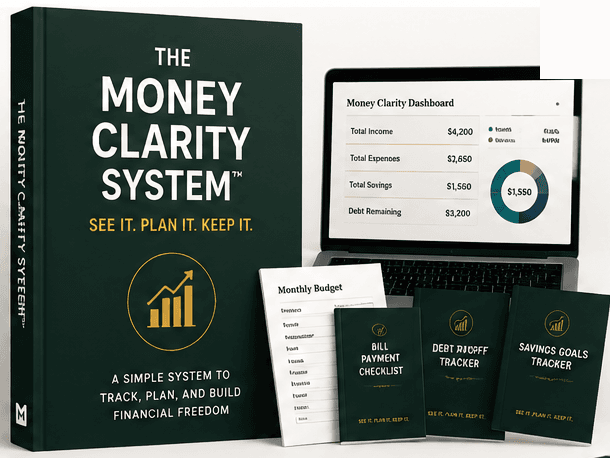
The Money Clarity System™
Ready to actually track it, not just read about it?
The full guide, dashboard, planner, challenges, and bonuses — one payment, lifetime access.
Related articles

Budgeting
How to Budget on a Low Income
Most budgeting advice assumes there's meaningful room to cut. On a low income, that assumption often doesn't hold — the approach needs to be different, not just smaller.
4 min read

Saving Money
Simple Ways to Save Money That Actually Add Up
The most effective savings tips aren't the most extreme ones — they're the ones specific and sustainable enough to actually stick past the first week.
4 min read

Saving Money
How to Save Your First $1,000
The first $1,000 is disproportionately important — not because of the amount itself, but because it's usually the milestone that makes saving feel real for the first time.
4 min read

Expense Tracking
How to Find Unnecessary Expenses in Your Budget
Generic advice to "cut unnecessary spending" doesn't say what's actually unnecessary. Here's a more specific way to find it in your own numbers.
3 min read