Saving Money
Simple Ways to Save Money That Actually Add Up

The most effective savings tips aren't usually the most dramatic ones — they're the ones specific and sustainable enough to actually last past the first week. A handful of small, consistent changes, applied over a full year, typically outperforms one extreme cut that gets abandoned within a month.
Audit Recurring Subscriptions First
This is one of the highest-leverage, lowest-effort savings actions available, because it's largely a one-time review with an ongoing benefit. How to Track Recurring Expenses covers building a complete list; canceling or downgrading unused ones doesn't require an ongoing habit the way many other savings tips do.
Use a Specific List Before Grocery Shopping
Shopping without a specific list tends to produce more impulse additions than shopping with one. This doesn't require a dramatic change in diet or budget — just deciding what's needed before entering the store, rather than deciding in the aisles.
Wait Before Non-Essential Purchases
A short, deliberate waiting period — even 24 to 48 hours — before a non-essential purchase reduces impulse buying meaningfully, since many impulse purchases lose their appeal once the initial urge passes. This doesn't need to apply to every purchase, just ones above a specific, personally meaningful threshold.
Review Recurring Bills for Better Rates
Insurance, phone plans, and internet service often have better rates available than what's currently being paid, either through a plan change or by contacting the provider directly. This is a periodic action — worth revisiting every year or so — rather than a daily habit, similar to a subscription audit.
Cook at Home More Deliberately, Not Absolutely
Rather than an all-or-nothing commitment to never eat out, identifying a specific number of home-cooked meals per week that feels sustainable — and sticking to that specific target — tends to hold up better than a vague, extreme goal that gets abandoned the first time it's inconvenient.
Use Cash or a Separate Account for Discretionary Spending
Setting aside a specific, limited amount for discretionary spending — in cash, or in a separate account used only for that purpose — creates a visible, concrete limit that's easier to respect than an abstract intention to "spend less" from a shared account with no clear boundary.
Buy Some Items Secondhand or Refurbished
For categories where condition matters less than function — some electronics, furniture, certain tools — secondhand or refurbished options can meet the same need at a meaningfully lower cost, without requiring a change in overall spending habits.
Automate Savings Before Considering It Discretionary Income
Covered in more depth in How to Save Money Every Month, automating a savings transfer before other spending happens is one of the most reliable ways to make sure any savings actually happens, rather than relying on discipline after the fact.
Negotiate or Downgrade Before Canceling Entirely
For services genuinely valued but priced higher than necessary, asking about a lower tier or a retention offer sometimes accomplishes the same savings as canceling outright, without giving up the service entirely.
Track Spending for a Month Before Deciding What to Cut
Rather than guessing which category to target, a month of real tracking — covered in How to Track Your Expenses — reveals which specific categories are actually worth focusing savings efforts on, rather than assuming based on general impression.
Why Small, Specific Changes Work Better Than Big, Vague Ones
An extreme, all-encompassing savings resolution is hard to sustain because it touches too many parts of daily life at once, and any single lapse can feel like total failure. A handful of specific, targeted changes — a subscription audit, a shopping list habit, a waiting period for impulse purchases — are each small enough to maintain individually, and their combined effect over a year is often larger than what the extreme approach would have achieved even if it had been sustained.
Choosing Where to Start
Pick two or three of these that fit naturally into an existing routine, rather than attempting all of them simultaneously. Consistency with a few specific changes beats a short burst of effort across every possible savings tip at once.
Want your savings from these changes tracked automatically so the impact is actually visible? MoneyMap includes a dashboard that shows exactly where the savings are showing up.
Frequently asked questions
Do small savings changes actually make a meaningful difference?
Individually, often not much — but several small, sustained changes together, over a full year, typically add up to a meaningful amount, more reliably than one large, dramatic cut that's hard to sustain.
Is it better to make one big change or several small ones?
Several small, sustainable changes generally hold up better over time than one large, disruptive change, which is more likely to be abandoned once the initial motivation fades.
Which category tends to offer the easiest savings?
Recurring subscriptions and memberships, since reviewing and canceling unused ones is typically a one-time action with an ongoing benefit, rather than a habit that has to be maintained daily.
Should every one of these tips be applied at once?
Not necessarily — picking two or three that fit a specific situation and applying them consistently tends to work better than attempting all of them simultaneously and sustaining none.
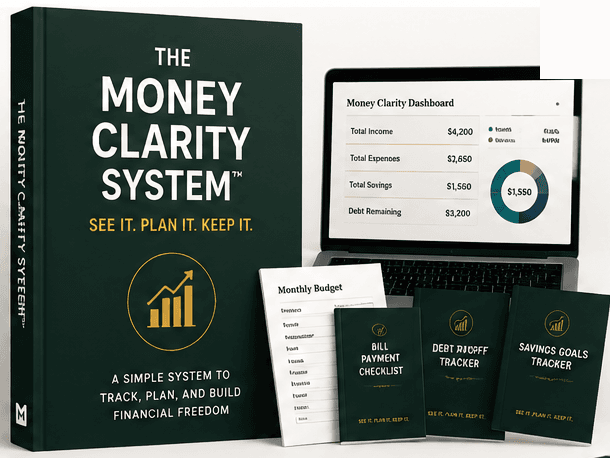
The Money Clarity System™
Ready to actually track it, not just read about it?
The full guide, dashboard, planner, challenges, and bonuses — one payment, lifetime access.
Related articles

Expense Tracking
How to Find Unnecessary Expenses in Your Budget
Generic advice to "cut unnecessary spending" doesn't say what's actually unnecessary. Here's a more specific way to find it in your own numbers.
3 min read

Expense Tracking
How to Track Recurring Expenses (Before They Add Up Unnoticed)
Recurring charges are uniquely easy to lose track of, because they don't require a new decision each time. A dedicated system catches what a general review often misses.
3 min read

Saving Money
How to Save Money on a Tight Budget
Generic savings advice assumes room that doesn't exist on a tight budget. A smaller, more deliberate approach works better than trying to force a standard percentage.
4 min read

Saving Money
How to Save Money Every Month (Consistently, Not Just Occasionally)
Saving "whatever's left" at the end of the month rarely produces consistent results, because there's rarely much left by the time it's checked. A different structure works better.
3 min read