Saving Money
How to Save Money Every Month (Consistently, Not Just Occasionally)

Saving "whatever's left" at the end of the month is one of the least reliable ways to actually build savings, for a simple reason: spending tends to expand to fill whatever's available, which means there's rarely much left by the time anyone checks. A system that saves consistently needs a different structure — one that doesn't depend on leftover money existing.
Why "Save What's Left" Doesn't Work Well
This approach puts saving last in line, after every other spending decision has already happened. By the time the end of the month arrives, whatever discretionary spending occurred has already claimed the money that might have gone to savings. Some months there's a surplus; many months there isn't, and the inconsistency makes it hard to build any real momentum.
Save First, Not Last
Flipping the order — setting aside the savings amount immediately when income arrives, before any other spending happens — removes the dependency on there being anything left over. This is sometimes called "paying yourself first," and it works because it treats savings as a fixed commitment, similar to a bill, rather than a hopeful leftover.
Automate the Transfer
A recurring automatic transfer to a separate savings account, scheduled for the same day income arrives, removes the need to remember or decide anew each month. Automation matters here specifically because it takes the decision out of a moment when competing spending priorities are most likely to win out.
Start With a Number That's Actually Sustainable
An overly ambitious savings target, set without checking whether it's realistic against actual expenses, tends to get abandoned within a month or two when it turns out to be unsustainable. A smaller, genuinely sustainable amount that continues every month builds more real savings over a year than a larger amount that only lasts a few months before being abandoned.
There's no universal correct percentage — a commonly referenced starting range is 10-20% of income, but the right number for a specific budget depends on fixed costs, existing debt, and other goals already being funded.
Give the Money a Specific Destination
A savings account with no specific purpose is easier to raid when something tempting comes up, because there's no clear reason not to. Assigning the saved money to a specific goal — an emergency fund, a specific purchase, a debt payoff supplement — gives it a defined job, which makes it psychologically easier to leave alone.
How to Build a Savings Plan covers structuring saved money around specific goals in more depth.
Increase the Amount Gradually, Not All at Once
Once a smaller, sustainable savings habit is established and comfortable, gradually increasing the amount — after a raise, after a debt is paid off and its payment amount is freed up — builds toward a larger savings rate without the shock of an unrealistic jump that risks breaking the habit.
Track Progress to Reinforce the Habit
Seeing a savings balance actually grow, even slowly, reinforces the habit far more than an abstract intention to save "when possible." How to Track Savings Progress covers keeping this visible on an ongoing basis.
What Undermines Consistent Saving
Treating savings as optional, leftover money rather than a fixed monthly commitment.
Setting an unsustainable amount that gets abandoned within a couple of months.
No automation, relying on remembering and deciding fresh every month.
No specific destination for the money, making it easier to justify spending it on something else.
Building the Habit Starting This Month
Pick a specific, sustainable amount — even a modest one — set up an automatic transfer for the day income arrives, and assign the money a specific purpose. That structure, maintained consistently, produces more real savings over time than a larger, inconsistent effort ever does.
Want to see your savings progress tracked automatically alongside the rest of your budget? MoneyMap includes a built-in savings tracker that updates as you go.
Frequently asked questions
Is it better to save a fixed amount or a percentage of income?
Either works, but a fixed amount is often easier to plan around for stable income, while a percentage adapts automatically if income varies. What matters most is that it's automated and specific, not which structure is used.
What if there's genuinely nothing left to save some months?
A smaller, sustained amount every month — even $10 or $20 — builds a more reliable habit than an inconsistent pattern of saving a lot some months and nothing others. Consistency matters more than the size of any single contribution.
Should saving happen before or after other expenses?
Before, ideally — automating a transfer right after income arrives, before it has a chance to get spent elsewhere, tends to produce far more consistent results than trying to save whatever happens to be left over.
How much should be saved each month?
There's no universal number — it depends on income, fixed costs, and current goals. A commonly referenced starting range is 10-20% of income, adjusted based on what's actually sustainable without breaking the budget elsewhere.
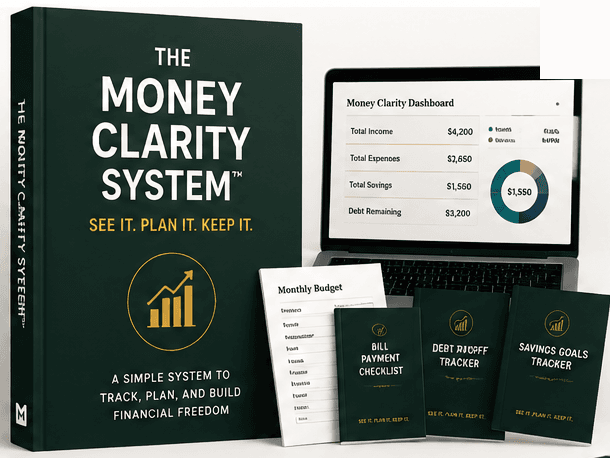
The Money Clarity System™
Ready to actually track it, not just read about it?
The full guide, dashboard, planner, challenges, and bonuses — one payment, lifetime access.
Related articles

Saving Money
How to Build a Savings Plan That Covers Multiple Goals
A single savings account trying to serve several goals at once makes it hard to know how any one of them is actually progressing. A structured plan separates them clearly.
4 min read

Financial Goals
How to Automate Your Savings So It Actually Happens
Manual saving depends on remembering and deciding every single time. Automation removes both requirements, which is most of why it works so much more consistently.
3 min read

Saving Money
How to Build an Emergency Fund (Even If You're Starting From Zero)
An emergency fund doesn't need to reach 'six months of expenses' to start protecting you. The gap between zero and a few hundred dollars matters more than most advice admits.
5 min read

Saving Money
How to Save Money on a Tight Budget
Generic savings advice assumes room that doesn't exist on a tight budget. A smaller, more deliberate approach works better than trying to force a standard percentage.
4 min read