Saving Money
How to Build a Savings Plan That Covers Multiple Goals

A single savings account trying to serve several goals at once — an emergency fund, a vacation, a future purchase — makes it hard to know how any one of them is actually progressing. A structured plan separates goals clearly, so each one has a visible, trackable target instead of blending into one ambiguous lump sum.
Why One Combined Savings Pool Causes Confusion
When emergency savings, a vacation fund, and a longer-term goal all share the same account, it's unclear how much is actually available for each purpose. Spending from the account for one goal can quietly eat into what was meant for another, without a clear moment where that tradeoff was consciously decided.
Step 1: List Every Active Savings Goal
Before building a plan, list every goal currently being saved toward — even ones without a firm plan yet. This typically includes an emergency fund, plus any specific goals: a purchase, a trip, a future expense, a longer-term target.
Step 2: Give Each Goal Its Own Specific Target and Deadline
For each goal, assign a specific dollar amount and a timeline, following the same structure covered in How to Set Savings Goals. A goal without a specific number and deadline is hard to plan capacity around, since there's no way to know how much it actually needs each month.
Step 3: Prioritize, Don't Split Evenly
With multiple goals and limited monthly savings capacity, splitting available money evenly across every goal often means none of them progress at a satisfying pace. A more effective approach: prioritize goals in order — typically a small emergency fund first, then whichever remaining goal is most time-sensitive or important — funding the top priority more heavily until it's reached or well underway, then shifting focus to the next.
Step 4: Separate the Money, Even Just Through Labels
Where possible, use separate accounts or clearly labeled sub-accounts for each goal. Some banks support named savings buckets within one account; where that's not available, even a simple tracked spreadsheet noting how much of a combined balance belongs to each goal accomplishes the same clarity.
This separation matters because it turns an abstract, combined balance into several specific, trackable progress bars — which is both more motivating and less prone to accidentally spending one goal's money on another.
Step 5: Automate Contributions According to the Priority Order
Rather than one single automated transfer to a generic savings account, structure automated transfers according to the priority order established in step 3 — the top-priority goal receiving its full planned contribution first, with remaining capacity flowing to the next goal in line.
Step 6: Revisit the Plan When Priorities or Income Change
A savings plan built around current priorities can become outdated as circumstances shift — a goal gets reached, a new one appears, income changes. Reviewing the plan every few months, and reallocating priority and capacity accordingly, keeps it matched to what actually matters right now rather than an outdated snapshot.
A Simple Example
Monthly savings capacity: $400.
Priority 1 — Emergency fund (until it reaches $1,000): $250/month.
Priority 2 — Vacation fund ($1,200 goal, 8 months out): $150/month.
Once the emergency fund reaches $1,000, that $250/month shifts — perhaps split between accelerating the vacation fund and starting a new priority goal, based on what matters most at that point.
What Makes Multi-Goal Savings Plans Fall Apart
No prioritization, spreading limited capacity so thin that no goal progresses meaningfully.
One combined account with no separation, making it unclear how much belongs to which goal and easy to accidentally spend one goal's savings on another.
No review as circumstances change, leaving an outdated allocation running long after priorities have shifted.
Building a Plan That Actually Tracks Multiple Goals
A savings plan doesn't need to be complicated to work — it needs each goal clearly defined, prioritized deliberately, and visible separately from the others. That structure turns "I'm trying to save for a few things" into a set of specific, trackable targets that can each be checked and adjusted individually.
Want to track multiple savings goals side by side without juggling separate spreadsheets? MoneyMap includes a savings tracker built to handle exactly this.
Frequently asked questions
Should each savings goal have its own separate account?
It helps, where practical — separate accounts (or clearly labeled sub-accounts, if the bank supports them) make it much easier to see progress on each goal individually, rather than one lump sum that blurs several goals together.
How should savings capacity be split across multiple goals?
Prioritized, not split evenly by default — typically an emergency fund first, then whichever goal is most time-sensitive or important, with the rest receiving a smaller or zero allocation until higher-priority goals are further along.
What if total savings capacity isn't enough to fund every goal at a reasonable pace?
That's common and worth acknowledging directly — it usually means sequencing goals rather than running all of them in parallel at an unsatisfying, slow pace each.
How often should a savings plan be reviewed?
Every few months, or whenever income or priorities change meaningfully — checking whether the current allocation across goals still reflects what actually matters most right now.
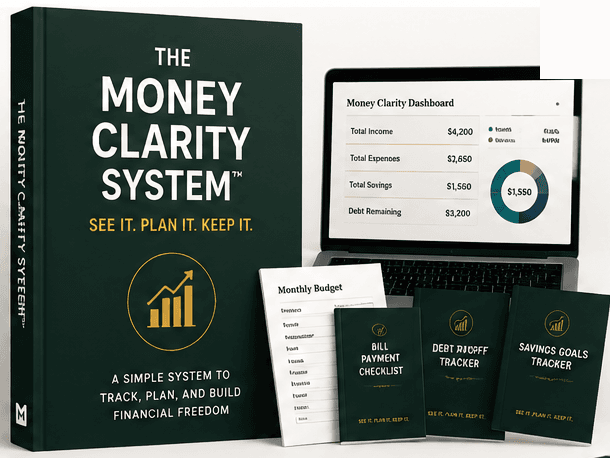
The Money Clarity System™
Ready to actually track it, not just read about it?
The full guide, dashboard, planner, challenges, and bonuses — one payment, lifetime access.
Related articles

Saving Money
How to Set Savings Goals You'll Actually Reach
A savings goal without a number and a deadline isn't really a goal — it's a hope. The difference between the two is what determines whether it actually gets reached.
4 min read

Saving Money
How to Save Money Every Month (Consistently, Not Just Occasionally)
Saving "whatever's left" at the end of the month rarely produces consistent results, because there's rarely much left by the time it's checked. A different structure works better.
3 min read

Saving Money
How to Track Savings Progress (So It Actually Feels Real)
Money quietly building in an account doesn't feel like progress unless it's actually visible. Tracking is what turns saving from an abstract habit into something motivating.
3 min read

Financial Goals
How to Automate Your Savings So It Actually Happens
Manual saving depends on remembering and deciding every single time. Automation removes both requirements, which is most of why it works so much more consistently.
3 min read