Financial Goals
Short-Term vs Long-Term Financial Goals: How to Balance Both

Treating every financial goal with the same monthly urgency — whether it's due in three months or ten years — tends to make short-term goals feel unrealistically demanding and long-term goals feel unnecessarily rushed. They're structurally different kinds of goals and benefit from different planning approaches.
What Separates Short-Term From Long-Term Goals
A short-term goal — generally reachable within about a year — needs a monthly contribution calculated against current income right now, since there's limited time for income or circumstances to shift favorably before the deadline arrives. A small emergency fund, a specific near-term purchase, and similar goals fall into this category.
A long-term goal — multiple years out — has more room to grow alongside income over time, absorb the occasional missed or reduced month, and be funded with a smaller starting contribution that increases gradually. A house down payment, a larger retirement contribution, or any goal with a distant deadline fits here.
Why Confusing the Two Causes Problems
Applying short-term urgency to a long-term goal — trying to fund a ten-year goal as aggressively as a six-month one — can create unnecessary strain on the current budget for a deadline that doesn't actually require it. Applying long-term patience to a short-term goal — treating a near-term deadline casually — risks missing it, since there's less time available to make up for a slow start.
Funding Both at the Same Time
Beyond an initial small emergency cushion — which reasonably takes priority regardless of what other goals exist — short-term and long-term goals can generally be funded simultaneously, each with its own specific monthly contribution calculated from its own timeline and target, rather than treating all goals as competing for exactly the same urgency.
How to Build a Savings Plan covers structuring multiple simultaneous goals, including a mix of short- and long-term ones, in more depth.
Keep Them in Separate Accounts
Blending short-term and long-term savings into one account makes it hard to know how much is genuinely available for the near-term goal versus reserved for something years away. Separate accounts — or at minimum clearly labeled sub-accounts — keep each goal's actual progress visible and prevent one from accidentally being spent on the other.
Revisit Long-Term Goals Less Frequently, but More Thoroughly
A short-term goal benefits from frequent, light check-ins — weekly or monthly — since its tighter timeline means drift needs to be caught quickly. A long-term goal benefits more from a less frequent but more thorough review — every six months to a year — checking whether the target amount, timeline, and monthly contribution still make sense given how income and priorities may have shifted over a longer stretch.
Adjust Long-Term Goals as Life Changes, Without Losing the Whole Plan
Long-term goals, by nature of their extended timeline, are more likely to need adjustment as real life unfolds — a career change, a new priority, a shift in circumstances. This is normal and doesn't mean the goal has failed; it means the plan gets recalculated with updated numbers, the same way a short-term goal's plan would be adjusted after a smaller, faster-arriving change.
A Reasonable Way to Balance Both
Fund the small initial emergency cushion first, then split available savings capacity between short-term goals (weighted toward their nearer deadlines) and long-term goals (started with a smaller, sustainable contribution that grows over time). Neither category should be ignored in favor of the other — a plan focused only on the short term risks never making progress on larger, more distant priorities, while a plan focused only on the long term leaves no protection against nearer-term needs.
Getting Both on Track
Identify which current goals are genuinely short-term and which are long-term, give each its own specific target and timeline, and fund them according to their actual urgency rather than treating every goal the same. That distinction alone tends to make both categories feel more achievable than lumping them together.
Want to track short-term and long-term goals separately without juggling multiple spreadsheets? MoneyMap includes a savings tracker built to handle several goals side by side.
Frequently asked questions
What counts as a short-term versus a long-term financial goal?
Short-term generally means reachable within about a year — a small emergency fund, a specific purchase. Long-term means multiple years out — a house down payment, larger retirement savings. The exact cutoff is less important than recognizing the different planning approach each needs.
Should short-term or long-term goals be funded first?
A small short-term cushion generally comes first, since it protects against unplanned expenses derailing everything else. After that, both can be funded simultaneously, prioritized based on urgency and importance rather than strictly by timeline length.
Does a long-term goal need the same monthly precision as a short-term one?
Less so — a long-term goal has more room to adjust its pace over time as income changes, while a short-term goal with a fixed deadline needs a more precise, consistent monthly contribution to stay on track.
Can the same savings account be used for both short-term and long-term goals?
It's cleaner to separate them, since blending timelines in one account makes it harder to know how much is actually available for the near-term goal versus reserved for something years away.
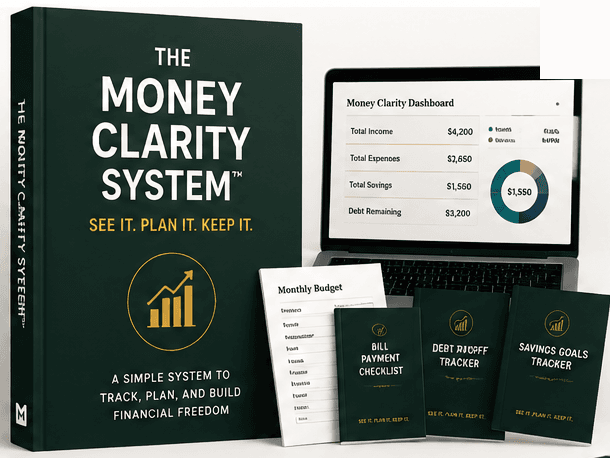
The Money Clarity System™
Ready to actually track it, not just read about it?
The full guide, dashboard, planner, challenges, and bonuses — one payment, lifetime access.
Related articles

Saving Money
How to Set Savings Goals You'll Actually Reach
A savings goal without a number and a deadline isn't really a goal — it's a hope. The difference between the two is what determines whether it actually gets reached.
4 min read

Saving Money
How to Build a Savings Plan That Covers Multiple Goals
A single savings account trying to serve several goals at once makes it hard to know how any one of them is actually progressing. A structured plan separates them clearly.
4 min read

Financial Goals
How to Reach Your Financial Goals Faster (Without Burning Out)
The fastest path to a financial goal isn't always the most extreme one. Sustainable acceleration usually beats an aggressive push that burns out in month two.
3 min read

Financial Goals
How to Set Financial Goals You'll Actually Follow Through On
"Save more money" isn't a goal — it's a direction. A goal has a number, a deadline, and a specific plan for getting there. Here's how to build one that actually works.
5 min read