Budgeting
How to Budget on a Low Income

Most budgeting advice assumes there's meaningful room to cut somewhere — a subscription here, dining out there. On a genuinely low income, that assumption often doesn't hold: fixed essential costs alone can consume most or all of what's coming in, and standard advice built around trimming discretionary spending misses the actual problem.
Standard Advice Often Doesn't Apply Directly
Rules like the 50/30/20 split (50% needs, 30% wants, 20% savings) are built around an income level where needs genuinely fit into half the budget. On a low income, needs — rent, utilities, food, transportation to work — frequently take up 70%, 80%, or more, leaving little or nothing for the discretionary and savings portions the rule assumes exist.
This isn't a discipline failure. It's a mismatch between the advice and the actual numbers, and budgeting on a low income needs an approach built around that reality rather than a percentage split designed for a different situation.
Start With What's Actually Fixed and Non-Negotiable
List housing, utilities, food, and any transportation cost required to keep earning income. These come first, not because other things don't matter, but because losing housing or utility access creates cascading problems far worse than any other budget category.
Being honest about which costs are truly in this category — versus costs that feel essential but actually have some flexibility — matters here more than on a higher income, because every dollar has less slack around it.
Track Every Expense, Even Small Ones
On a tighter budget, small untracked expenses have a proportionally larger effect on whether the month actually balances. A few untracked small purchases that wouldn't meaningfully affect a larger budget can be the entire difference between a low-income budget working and falling short.
How to Track Your Expenses covers the general process; on a low income, it's worth applying with more consistency than the "good enough" approach that works fine on a larger budget.
Look for Real, Specific Reductions — Not Vague Belt-Tightening
"Spend less" isn't actionable when there's little discretionary spending to begin with. A more useful approach: look for specific, concrete costs that can be reduced without affecting anything essential — a subscription that isn't being used, a phone plan that could be downsized, a recurring cost that crept in without a deliberate decision.
These individual reductions won't be large, but on a tight budget, even small amounts freed up have a meaningful proportional effect.
Build the Smallest Possible Buffer First
A full emergency fund can feel completely out of reach on a low income, and treating "three to six months of expenses" as the starting goal can be discouraging enough to stop anyone from starting at all. A much smaller first target — even $100 to $200 — still meaningfully reduces the chance that one unplanned expense turns into new debt, and it's a genuinely achievable first step.
Check for Assistance and Benefits Actually Available
Depending on location and circumstances, there may be real assistance programs, tax credits, or benefits that go unclaimed simply because they weren't checked. This isn't a substitute for budgeting, but it's a legitimate part of the full financial picture that's sometimes skipped in generic advice.
Name the Structural Gap Honestly, If It Exists
If fixed essential costs alone meet or exceed income, no amount of budgeting technique closes that gap — it's a structural problem, not a discipline one. In that situation, the honest options are reducing a specific fixed cost (renegotiating a bill, finding lower-cost housing or transportation if realistic) or increasing income, not further tightening an already-tight discretionary budget that may not have much left to give.
Recognizing this clearly, rather than blaming a budgeting approach for not fixing a gap it structurally can't fix, is itself a useful and honest step.
What Actually Helps on a Low Income
Tracking every expense closely, since small amounts matter proportionally more.
Prioritizing true essentials clearly, rather than applying a generic percentage split that doesn't fit.
Making specific, small reductions, rather than a vague commitment to "spend less."
Starting with a small, achievable buffer goal, rather than an intimidating full emergency fund target.
Being honest about structural gaps, rather than treating every shortfall as a budgeting failure.
Moving Forward
Budgeting on a low income is real, ongoing work, and it deserves an approach built around the actual numbers involved — not advice designed for a budget with more room in it. Small, consistent steps — tracking closely, cutting specifically, building a modest buffer — add up over time, even when the starting point feels tight.
A tool that makes tracking and category visibility easier can matter more on a tight budget than a looser one, since there's less margin for untracked spending to go unnoticed. MoneyMap is built to make that visibility simple, without a recurring subscription cost added on top of an already tight budget.
Frequently asked questions
Does the 50/30/20 rule work on a low income?
Often not directly — on a low income, needs frequently take up more than 50% of income on their own, leaving little or nothing for the 30/20 split. A percentage-based rule works better as a rough reference than a literal target in this situation.
What should be prioritized first on a tight budget?
Housing, utilities, and food, in that order for most situations — the costs that keep basic stability intact. A small emergency cushion, even $10 to $20 a week, comes next, before anything discretionary.
Is it worth tracking every single expense on a low income?
Yes, more than on a higher income, because there's less margin for error. On a tight budget, small unnoticed expenses have a proportionally bigger effect on whether the month balances.
What if fixed expenses alone exceed income?
That's a structural gap that budgeting techniques alone can't close — it points to either reducing a fixed cost (housing, a loan, insurance) or increasing income, and it's worth naming clearly rather than treating it as a discipline problem.
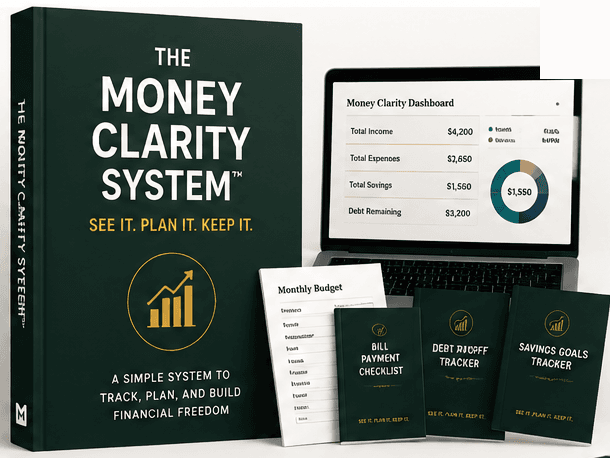
The Money Clarity System™
Ready to actually track it, not just read about it?
The full guide, dashboard, planner, challenges, and bonuses — one payment, lifetime access.
Related articles

Saving Money
How to Save Money on a Tight Budget
Generic savings advice assumes room that doesn't exist on a tight budget. A smaller, more deliberate approach works better than trying to force a standard percentage.
4 min read

Debt Management
How to Stop Living Paycheck to Paycheck
The paycheck-to-paycheck cycle isn't usually about how much someone earns — it's about a structural gap that keeps pulling every paycheck to zero before the next one arrives.
5 min read

Expense Tracking
How to Find Unnecessary Expenses in Your Budget
Generic advice to "cut unnecessary spending" doesn't say what's actually unnecessary. Here's a more specific way to find it in your own numbers.
3 min read

Saving Money
Simple Ways to Save Money That Actually Add Up
The most effective savings tips aren't the most extreme ones — they're the ones specific and sustainable enough to actually stick past the first week.
4 min read