Debt Management
Common Debt Payoff Mistakes (And How to Avoid Them)

Most debt payoff plans that stall out don't fail from a lack of genuine commitment — they fail for a small, recurring set of structural mistakes that show up across most first attempts. Recognizing them in advance is most of what it takes to avoid them.
Mistake 1: Skipping the Emergency Cushion
Committing every available dollar to debt payoff, with zero savings set aside, feels efficient but creates a specific vulnerability: the first unplanned expense — a repair, a medical bill — has nowhere to come from except a card, adding new debt right back on top of what's being paid down.
Instead: build a small cushion, even $500 to $1,000, before going all-in on extra debt payments.
Mistake 2: Splitting Extra Payments Evenly Across Every Debt
It feels fair to put a little extra toward every balance at once, but this dilutes the effect — extra payments concentrated on one debt at a time clear that balance faster, freeing up its full payment amount to roll onto the next one sooner.
Instead: choose one clear order — snowball or avalanche — and direct all extra payments to one debt at a time.
Mistake 3: Continuing to Charge New Purchases
Using a card actively being paid down adds new interest-accruing balance at the same time payments are reducing it, which can leave the total balance roughly flat for months even while real payments are happening consistently.
Instead: shift to debit or cash for regular spending until the targeted balance is meaningfully reduced or cleared.
Mistake 4: No Specific, Calculated Timeline
A goal to "get out of debt" without a calculated date attached is hard to stay motivated by, since there's no way to check whether progress is on pace or falling behind.
Instead: calculate a specific debt-free date from the real numbers, covered in How to Create a Debt Payoff Plan.
Mistake 5: Picking an Unsustainable Extra Payment Amount
An overly aggressive extra payment, not checked against the real budget, tends to break down within a few months — either abandoned outright or quietly undone by new debt covering gaps the aggressive plan created elsewhere.
Instead: calculate the extra amount from actual income and expenses, not an ambitious guess.
Mistake 6: Not Automating Extra Payments
Relying on remembering to make an extra payment manually each month means it competes with other spending decisions in the moment — and tends to lose more often than it should.
Instead: automate the extra payment the same way a fixed bill would be automated.
Mistake 7: Ignoring an Incomplete Debt List
Making payoff decisions without a complete, accurate list of every debt — balance, rate, minimum — means the plan is built on a partial picture, which can lead to prioritizing the wrong debt first.
Instead: build a complete list before choosing a payoff order, covered in How to Organize Multiple Debts.
Mistake 8: Treating a Missed Extra Payment as Total Failure
One month with no extra payment, due to a tight budget or an unplanned expense, doesn't undo the whole plan — but treating it as a complete failure sometimes leads to abandoning the plan altogether rather than simply resuming the following month.
Instead: treat a missed month as a temporary pause, not a reason to give up on the plan entirely.
Mistake 9: Never Revisiting the Plan
A payoff plan calculated once, at the start, can become outdated as circumstances change — income shifts, a debt gets cleared, an emergency fund reaches its target freeing up money to redirect.
Instead: revisit and recalculate the plan every few months.
Mistake 10: Not Accounting for a Retirement Match
Focusing every available dollar on debt payoff while skipping an available employer retirement match means giving up what's effectively free, guaranteed money — a cost that's easy to overlook in the focus on debt.
Instead: capture at least the full employer match before directing everything else toward debt.
The Pattern Behind These Mistakes
Most of these come down to either an unsustainable plan (too aggressive, no cushion) or a diluted one (payments spread too thin, no clear order). Avoiding both — building a plan that's realistic and concentrated — is what separates a payoff plan that actually finishes from one that stalls out partway through.
Want a payoff plan built to avoid these traps from the start? MoneyMap includes a debt payoff planner designed around exactly this.
Frequently asked questions
What's the most common mistake in debt payoff plans?
Skipping a small emergency cushion before starting aggressive payoff. Without one, the first unplanned expense typically goes back onto a card, adding new debt on top of what's being paid down.
Is splitting extra payments evenly across every debt a mistake?
Generally, yes — it dilutes the effect of extra payments across too many balances at once, compared to concentrating them on one debt at a time until it's cleared.
Does continuing to use a card while paying it off cause real problems?
Yes — new charges accrue interest the same way the existing balance does, which can leave the total balance roughly flat for months even while real payments are being made.
Is it a mistake to not have a specific payoff timeline?
It makes the plan harder to stay motivated by, since there's no way to measure whether progress is on pace. A calculated timeline turns an abstract goal into something trackable.
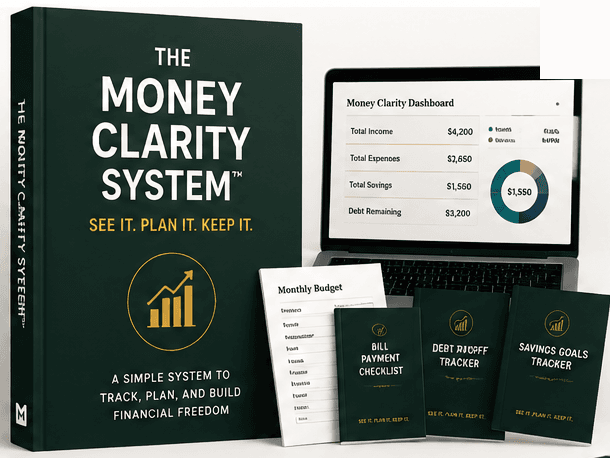
The Money Clarity System™
Ready to actually track it, not just read about it?
The full guide, dashboard, planner, challenges, and bonuses — one payment, lifetime access.
Related articles

Debt Management
How to Pay Off Debt: A Complete, Realistic Guide
Paying off debt isn't complicated in concept — it's a specific process that most people never actually lay out in full. Here's the complete version.
3 min read

Debt Management
How to Create a Debt Payoff Plan (With a Real Timeline)
A list of debts isn't a plan. A plan has an order, a monthly number, and a realistic date attached — here's how to build one from scratch.
3 min read

Debt Management
Debt Snowball vs Debt Avalanche: Which One Pays Off Debt Faster?
Both methods pay off the same debt eventually. They differ in what keeps a person actually going — and that difference matters more than the math suggests.
4 min read

Debt Management
How to Organize Multiple Debts Into One Clear Plan
Debt spread across several cards, loans, and accounts is hard to make decisions about until it's all in one place. Organizing it is a distinct first step, before any payoff strategy.
3 min read