Money Management
Financial Goals for Beginners: Where to Start

For someone just starting out, the hardest part of financial goals usually isn't understanding the concept — it's knowing which ones actually deserve priority first, when everything from an emergency fund to retirement to debt payoff can feel equally urgent at once.
Why Beginners Often Struggle With Prioritization, Not Motivation
It's rarely a lack of motivation that stalls a beginner's financial goals — it's the sense that everything matters simultaneously, which makes it hard to know where to actually direct limited time and money first. Without a clear order, the natural response is often to spread thin effort across everything at once, which tends to produce slow progress on all of it rather than real progress on any one thing.
The First Goal: A Small Emergency Cushion
Before anything else, a small emergency fund — $500 to $1,000 — deserves priority. It's achievable relatively quickly for most budgets, and it protects every other financial goal that comes after it: without this cushion, the first unplanned expense typically derails debt payoff or savings progress by forcing a return to credit. How to Build an Emergency Fund covers this specific goal from zero.
The Second Goal: Address High-Interest Debt
With a small cushion in place, high-interest debt — most commonly credit cards — is usually the next priority, since its interest cost compounds the longer it carries a balance. How to Pay Off Debt covers building a full payoff plan.
The Third Goal: Build a Working Budget, If One Doesn't Exist Yet
A working budget isn't always framed as a "goal," but for a beginner it functions as one — a specific, achievable target (a first working draft, refined over the first month or two) that makes every subsequent goal easier to plan and fund accurately. How to Create a Monthly Budget covers building this from scratch.
The Fourth Goal: Grow Savings Further
Once a cushion exists and high-interest debt is under control, growing savings toward a fuller emergency fund (one to three months of expenses, eventually more) or toward a specific goal becomes the next reasonable priority. How to Set Financial Goals covers structuring this kind of goal properly.
Break Larger Goals Into Smaller Milestones
A goal that will take a year or more can feel too distant to stay motivating through the early months. Breaking it into smaller milestones — 25%, 50%, 75% of the way there — gives more frequent moments of visible progress along the way, which matters more for a beginner still building the habit of pursuing financial goals at all.
Avoid Starting With Too Many Goals at Once
It's tempting, once motivated, to set several goals simultaneously — an emergency fund, debt payoff, a savings goal, maybe even starting to invest. For a beginner specifically, this tends to spread limited money and attention too thin to make meaningful progress on any of them. Starting with one or two, in the priority order above, and adding more once the first ones are underway or complete, produces better results than an ambitious simultaneous start.
What Doesn't Need to Happen Yet
Investing, retirement account optimization, and more advanced financial planning are worth learning eventually, but they're not where a beginner's financial goals need to start. The foundational goals — a cushion, manageable debt, a working budget, growing savings — matter more in the early stages and make everything that comes after easier to approach with confidence.
Setting the First Goal Today
Pick the goal that matches where things currently stand — likely the small emergency cushion, if it doesn't exist yet — and follow the specific process for building it, rather than trying to address every financial priority simultaneously. Progress on one clear goal, completed, builds both real financial footing and the confidence to tackle the next one.
Want a system that helps prioritize and track your first financial goals without needing to figure out the order yourself? MoneyMap is built to guide exactly this kind of beginner-friendly structure.
Frequently asked questions
What should a beginner's very first financial goal be?
A small emergency cushion, commonly $500 to $1,000. It's achievable relatively quickly and protects every other financial goal from being derailed by the next unplanned expense.
Is it a mistake to set a big, ambitious goal as a beginner?
Not inherently, but a big goal works better when broken into smaller milestones along the way — otherwise it can feel too distant to stay motivating through the early months.
How many financial goals should a beginner have at once?
One or two, generally. Starting with too many goals simultaneously spreads limited money and attention thin, which tends to slow progress on all of them rather than completing any one meaningfully.
Does a beginner need to understand investing before setting financial goals?
No — the earliest useful goals (an emergency fund, paying down high-interest debt, a basic budget) don't require investing knowledge. That can come later, once the foundation is in place.
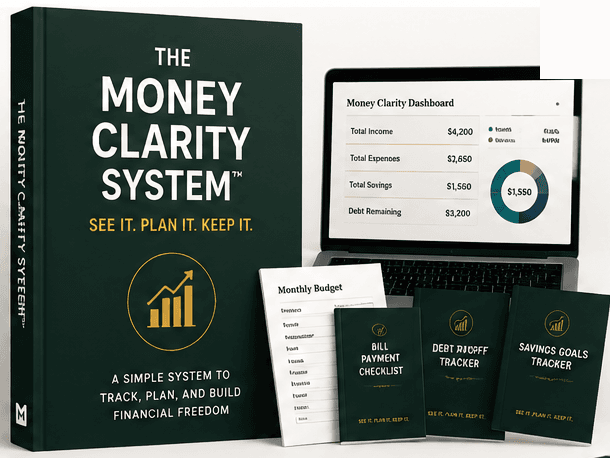
The Money Clarity System™
Ready to actually track it, not just read about it?
The full guide, dashboard, planner, challenges, and bonuses — one payment, lifetime access.
Related articles

Financial Goals
How to Set Financial Goals You'll Actually Follow Through On
"Save more money" isn't a goal — it's a direction. A goal has a number, a deadline, and a specific plan for getting there. Here's how to build one that actually works.
5 min read

Money Management
Personal Finance for Beginners: Where to Actually Start
Personal finance advice usually arrives as an unordered pile: budget, save, invest, pay off debt, build credit. Here's the order that actually makes sense to tackle it in.
4 min read

Saving Money
How to Build an Emergency Fund (Even If You're Starting From Zero)
An emergency fund doesn't need to reach 'six months of expenses' to start protecting you. The gap between zero and a few hundred dollars matters more than most advice admits.
5 min read

Financial Goals
How to Reach Your Financial Goals Faster (Without Burning Out)
The fastest path to a financial goal isn't always the most extreme one. Sustainable acceleration usually beats an aggressive push that burns out in month two.
3 min read