Budgeting
How to Budget on a Single Income

Two-income households have a structural safety net that's easy to take for granted: if one paycheck comes up short, or an unexpected expense lands hard, there's usually a second income in the same house to lean on. A single-income household doesn't have that — every planning decision has to account for the fact that there's no second paycheck quietly covering the gap.
The Core Difference Isn't the Amount — It's the Redundancy
A common misconception is that single-income budgeting is really just a version of low-income budgeting. It's not — a single-income household can have a perfectly comfortable paycheck and still face a distinct planning challenge that a two-income household with a similar combined income doesn't: there's no built-in backup. If the one earner is sick, laid off, or simply has an off month, there's no second income quietly keeping things afloat while it gets sorted out.
This changes what actually matters most in the budget — not just keeping monthly numbers balanced, but building real redundancy into the plan.
Build a Larger Emergency Fund Than the Standard Guideline
Common financial guidance suggests three to six months of essential expenses in an emergency fund. For a single-income household, especially one supporting dependents, leaning toward the higher end of that range — or slightly beyond it — is a reasonable adjustment given the lack of a second income to bridge a gap.
Example — essential monthly expenses of $3,200:
| Emergency fund target | Months covered |
|---|---|
| Standard guideline (low end) | 3 months = $9,600 |
| Single-income adjustment | 6 months = $19,200 |
Reaching the higher target doesn't have to happen all at once — building toward it steadily, even $50 or $100 a month, moves the household toward genuine redundancy over time.
Budget Off a Conservative Income Estimate
If the single income has any variability at all — commission, bonuses, overtime, freelance work — building the regular monthly budget around the lowest realistic month, rather than an average, keeps the plan solvent even in a leaner stretch. Any income above that baseline becomes a bonus to direct toward savings, debt, or the emergency fund buffer, rather than money that's already been assigned to regular spending before it's even confirmed.
Protect the Income Itself, Not Just the Budget
With only one income source, protecting that source matters as much as budgeting around it. A few considerations worth reviewing:
- Disability insurance, if not already provided through an employer, replaces a portion of income if illness or injury prevents work — a risk that's structurally more serious for a single-income household than a two-income one.
- Life insurance, particularly if dependents rely on the income, ensures the household isn't left without any financial foundation in a worst-case scenario.
- Keeping job skills current and maintaining some professional network, even while employed, reduces the time and difficulty of finding new income if the current position ends unexpectedly.
None of these are budgeting line items in the traditional sense, but they function as a form of insurance against the exact vulnerability that defines single-income households.
Assign Specific Roles to the Budget, Even With One Income
In a household with a partner who isn't earning the income — whether managing a home, caring for children, in school, or between jobs — it helps to structure the budget so both partners have some individual discretionary spending, even though only one paycheck is funding it. This isn't about equal contribution to the household's finances; it's about avoiding a dynamic where one partner has to ask permission for every personal purchase while the other doesn't.
A simple structure:
- Shared/household expenses: rent, utilities, groceries, bills
- Emergency fund and savings contributions
- Individual discretionary spending for each adult — the same or a fair, agreed amount for both, regardless of who earned the income that funds it
Reduce Fixed Monthly Obligations Where Possible
Because there's no second income to absorb a shock, keeping fixed monthly commitments — the ones that don't flex if income drops temporarily — as lean as realistically possible adds meaningful flexibility. This doesn't mean eliminating every subscription or comfort, but it does mean being deliberate about which fixed costs are truly worth locking in, given that a single-income household has less room to simply "make it work" if the income itself takes a hit.
Review the Budget More Frequently Than a Two-Income Household Might
With one income source, a change — a raise, a pay cut, a schedule change, a new expense — has an outsized effect on the whole household's finances, since there's no second income diluting the impact. A monthly review, rather than a quarterly or occasional one, catches these shifts early enough to adjust the plan before a small change becomes a real problem.
A Sample Monthly Budget for a Single-Income Household
Single income of $5,400/month gross, supporting a household of three:
| Category | Monthly amount |
|---|---|
| Housing | $1,500 |
| Utilities & insurance | $420 |
| Groceries | $700 |
| Transportation | $380 |
| Childcare or dependent costs | $600 |
| Debt payments | $350 |
| Emergency fund contribution (building toward 6 months) | $300 |
| Retirement/savings | $250 |
| Discretionary (split between both adults) | $400 |
| Total | $4,900 |
Building in a meaningful emergency fund contribution and clear discretionary amounts for both adults — even though only one paycheck funds everything — reflects the two priorities that matter most in a single-income structure: real redundancy, and a system both people feel genuinely part of.
Reentering the Workforce: Planning for a Potential Second Income
Some single-income households are single-income by circumstance rather than permanent choice — a partner caring for young children, finishing school, or between jobs, with a plausible future where a second income re-enters the picture. In these cases, it can help to budget conservatively as if the single income were permanent, rather than anticipating a second income that hasn't arrived yet. If and when it does, that income can go toward accelerating goals — extra debt payoff, a faster-growing emergency fund, increased retirement contributions — rather than immediately expanding the baseline lifestyle to match, which is the same lifestyle-creep risk that shows up after any income increase.
Single-Income by Choice vs. Single-Income by Circumstance
There's a meaningful difference between a household that's single-income by deliberate choice — one partner choosing not to work outside the home, for instance — and one that's single-income because a job loss, health issue, or other circumstance removed a second income unexpectedly. The budgeting mechanics described here apply to both, but the emotional starting point is often very different, and it's worth acknowledging that difference rather than assuming every single-income household is in the same position.
For a household that became single-income unexpectedly, the priority is often stabilizing the budget around the new reality first — a conservative baseline, protecting what savings exist — before turning to longer-term goals like an expanded emergency fund target. For a household that's single-income by ongoing choice, there's typically more room to plan deliberately from the outset, since the structure isn't a reaction to a recent disruption.
Building an Income Diversification Plan Over Time
Even within a single-income structure, there's often room to reduce total reliance on one paycheck without necessarily adding a second full-time earner. A modest side income, freelance work, or a small business run by the non-earning partner can add a partial second income stream — not enough to change the household's core single-income planning, but enough to add another layer of redundancy on top of the emergency fund and income protection already in place. This isn't necessary for a stable single-income budget to work, but it's worth considering as a longer-term goal for households that want to reduce their dependence on one income source over time.
Single-Income Doesn't Mean Fragile — It Means Deliberate
A single-income household can be every bit as financially stable as a two-income one — it just requires being more intentional about the exact things a second income would otherwise cover automatically: a bigger buffer, protected income, and a budget built on a conservative, realistic number rather than an optimistic average.
The Money Clarity System includes a savings goals tracker and monthly dashboard built to help single-income households track progress toward a real emergency fund buffer, alongside the rest of the monthly budget.
Frequently asked questions
Is a single-income budget the same as a low-income budget?
Not necessarily — single-income refers to the number of earners in a household, not the income level. A household with one earner making $95,000 and a household with one earner making $35,000 are both single-income, but face very different budgeting realities. The core challenge shared by both is having no second paycheck to fall back on, not the size of the paycheck itself.
How big should an emergency fund be for a single-income household?
A commonly cited range is three to six months of essential expenses, and single-income households — especially those supporting dependents — often lean toward the higher end of that range, since there's no second income to bridge a gap if the sole earner loses work or income temporarily.
What if the single income is irregular, like freelance or commission-based work?
Budgeting off the lowest realistic month from recent history, rather than an average, prevents a leaner month from causing a shortfall. Any income above that baseline in a stronger month can go toward savings, debt, or the buffer fund instead of being built into the regular monthly spending plan.
Should a single-income household with one working partner still track two people's spending separately?
It can help, even with one income source — separate discretionary spending amounts for each adult in the household (regardless of who earns the paycheck) tend to reduce friction, since both people have some money that isn't subject to the other's approval, even though only one income is funding the whole household.
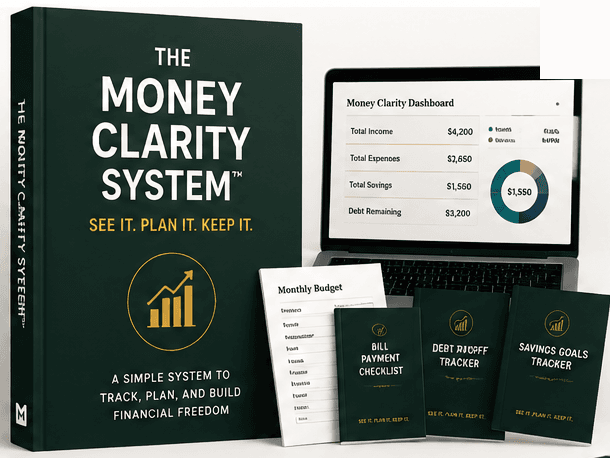
The Money Clarity System™
Ready to actually track it, not just read about it?
The full guide, dashboard, planner, challenges, and bonuses — one payment, lifetime access.
Related articles

Budgeting
How to Budget on a Low Income
Most budgeting advice assumes there's meaningful room to cut. On a low income, that assumption often doesn't hold — the approach needs to be different, not just smaller.
4 min read

Budgeting
How to Create a Monthly Budget (That Fits Your Actual Paycheck)
A monthly budget only works if it matches how income actually arrives — not a single averaged total that ignores the timing of real paychecks and real bills.
4 min read

Saving Money
How to Build a Savings Plan That Covers Multiple Goals
A single savings account trying to serve several goals at once makes it hard to know how any one of them is actually progressing. A structured plan separates them clearly.
4 min read