Money Management
What to Do After a Bad Spending Month (Instead of Giving Up on Your Budget)

The bank balance is lower than it should be, the credit card statement has a number that doesn't match the plan, and the instinct is often to feel like the whole budget failed — or worse, like budgeting just doesn't work for you personally. Neither is usually true. One overspent month is information, not a verdict, and what happens in the next few days matters more than the month that already happened.
The First Step Isn't Cutting Spending — It's Looking at What Actually Happened
Before making any changes, a clear-eyed review of exactly what happened is more useful than an immediate, emotional reaction to cut everything. Pull the actual transactions from the overspent month and sort them into a few honest categories:
- Predictable but unbudgeted — an expense that should have been expected but wasn't planned for (a gift, an event, a seasonal cost)
- Genuinely unplanned — something that came up with no real way to have seen it coming
- A pattern that's been building — a category that's crept up gradually over several months, not just this one
- Emotional or stress-driven spending — purchases made to cope with a hard week, not from a specific need
This isn't about assigning blame — it's about figuring out which of these actually happened, because the fix is different for each one.
Separate "This Month Was Unusual" From "This Category Is Wrong"
A single unusual month — a friend's wedding, an unexpected repair, a rough emotional stretch — doesn't necessarily mean anything about the budget itself is broken. It might just mean this particular month had real, one-time pressures that a normal month doesn't.
But if the review shows the same category running over month after month — dining out, for example, consistently coming in $150 over the budgeted amount — that's not a series of unusual months. That's a sign the budgeted number for that category was never actually realistic, and no amount of willpower is going to make a category work when its target was wrong from the start.
Recalculate the Number Instead of Just Trying Harder
If a category is consistently over budget, the most effective fix is usually adjusting the number to reflect actual spending, not repeating the same unrealistic target and hoping for a different result next month. A dining-out budget of $150 that's consistently running $300 isn't a discipline problem — it's a budget built on the wrong number.
This doesn't mean giving up on reducing spending in that category if it's genuinely too high for the household's goals — it means starting from an honest number, then working it down deliberately, rather than starting from a number that was never realistic in the first place.
Address a Credit Card Balance Directly, Not Silently
If the overspending went onto a credit card, naming the specific amount matters. "I overspent by $340 this month" is a concrete, solvable problem with a clear payoff plan. Letting that $340 blend invisibly into an ongoing card balance, without a specific plan to pay it down, is how a single rough month turns into permanent, compounding debt.
A simple approach: add the overspent amount as a specific line in next month's budget — an "overspend catch-up" payment — rather than treating it as if it never happened.
Example:
| This month | Next month | |
|---|---|---|
| Regular budget | Overspent by $340 | Back to normal |
| Catch-up payment | — | $170/month for 2 months |
Two months of a modest, planned catch-up payment resolves a single rough month cleanly, without derailing the following months' budget entirely in one lump-sum scramble.
Don't Skip the Review Because It Feels Uncomfortable
There's a real temptation to just not look closely at an overspent month — to close the app, ignore the statement, and hope next month goes better without actually understanding what happened this month. This is usually the single biggest reason overspending repeats: the pattern never gets identified because it never gets reviewed honestly.
A short, judgment-free review — ideally within the first week of the new month, while the details are still fresh — is far more useful than either harsh self-criticism or complete avoidance. Neither extreme actually produces better information about what to change.
A Worked Example: Reviewing a Specific Overspent Month
The situation: a monthly budget of $4,200 came in at $4,610 — $410 over.
The review breaks it down:
| Category | Budgeted | Actual | Difference | Type |
|---|---|---|---|---|
| Groceries | $500 | $540 | +$40 | Minor, within normal range |
| Dining out | $150 | $290 | +$140 | Pattern — third month in a row over |
| Gift for a friend's baby shower | $0 | $85 | +$85 | Predictable but unbudgeted |
| Car repair | $0 | $145 | +$145 | Genuinely unplanned |
What this review reveals: dining out isn't a one-time slip — it's been over budget for three consecutive months, meaning the $150 target itself is unrealistic and needs to be raised, likely closer to $250, with a real plan to work it down from there if reducing it is still a goal. The baby shower gift is the kind of expense that a "gifts and celebrations" sinking fund would have already covered. The car repair is a genuine surprise, exactly the kind of expense an emergency fund exists for.
The result: three completely different fixes for three completely different causes — none of which would have been visible without breaking the overage down by category instead of just looking at the total.
Separating Guilt From Useful Reflection
It's worth being direct about this: feeling bad about an overspent month doesn't actually produce better financial decisions. Guilt tends to either trigger avoidance (not looking at the numbers at all) or an overcorrection (an unrealistically strict budget the following month that fails within a week). Neither leads anywhere useful.
A more productive frame treats the review like a diagnostic, not a moral judgment: what specifically happened, what caused it, and what specific change — if any — actually addresses the cause. This framing tends to produce real, lasting adjustments; guilt-driven reactions tend to produce short bursts of extreme restriction that don't hold.
Rebuilding Trust in the Budget Itself
A less obvious cost of a bad spending month is the effect it has on confidence in the budget as a tool. After overspending, it's common to start feeling like the budget "doesn't really work" or "isn't worth the effort" — a reaction that, if acted on, removes the exact system that would help identify and fix the problem.
Rebuilding that trust usually comes from seeing the review process actually work — identifying a specific, fixable cause, making one concrete adjustment, and then seeing the following month come in closer to plan. That small proof point tends to matter more than any amount of resolving to "just do better," because it demonstrates the system responding to real information rather than asking for more willpower against an unrealistic target.
How Often Is "Occasional" Overspending Actually Normal?
There's no universal number, but as a general reference point, an occasional month running 5-10% over budget — driven by identifiable, mostly one-time causes — is a normal part of even a well-run budget, not a sign that something is fundamentally broken. What's worth real attention is a pattern: the same category running over for three or more consecutive months, or overspending that's become the norm rather than the exception. That pattern is the signal that something structural needs to change, rather than something that just needs a single month's review.
Rebuilding Momentum Without an All-or-Nothing Reset
One overspent month doesn't require blowing up the entire budget and starting from a completely blank system. It requires: reviewing what happened, adjusting any category that was consistently unrealistic, addressing any resulting balance with a specific plan, and moving forward with the same system — slightly improved by what the rough month revealed.
Treating a bad month as data instead of a failure is what actually keeps a budget working long-term. Every realistic, sustainable budget has occasional rough months built into its history — the difference between a budget that works and one that gets abandoned isn't the absence of bad months, it's what happens right after one.
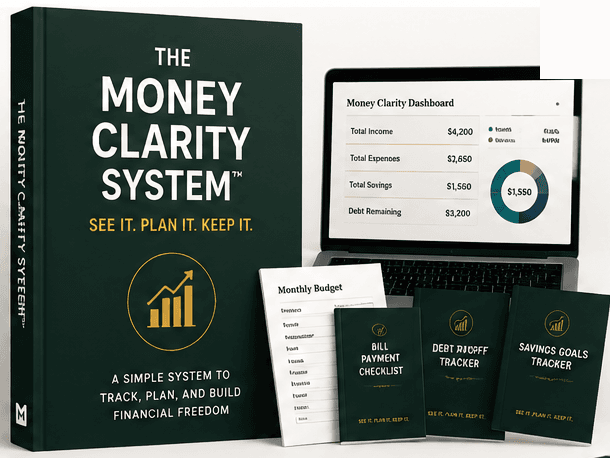
If a specific category keeps running over, The Money Clarity System includes a monthly budget tracker that makes it easy to spot patterns like this early — before they turn into a full month of overspending.
Frequently asked questions
Should a budget be abandoned after a bad month?
No — one overspent month is data, not a verdict on the whole system. Abandoning the budget after a single rough month removes the exact tool that would help identify what went wrong and prevent it from repeating.
Is it normal to overspend occasionally, even with a good budget?
Yes. Even a well-built, realistic budget will have off months — a higher-than-usual number of social events, an unplanned expense, a stressful stretch that led to more comfort spending. The measure of a working budget isn't a perfect record; it's whether the pattern gets caught and addressed.
How do you catch up financially after overspending, if a credit card was used?
Pay down the specific amount that was overspent as a priority in the following month or two, treating it like a temporary added expense rather than folding it invisibly into ongoing card debt. Naming the exact amount and a payoff timeline keeps it from quietly becoming permanent balance.
What if overspending has happened multiple months in a row?
A repeated pattern across several months is a signal that a specific budget category is consistently unrealistic, not that willpower is repeatedly failing. Adjusting the actual number for that category to reflect real spending is usually more effective than trying harder with a number that was never accurate to begin with.
The Money Clarity System™
Ready to actually track it, not just read about it?
The full guide, dashboard, planner, challenges, and bonuses — one payment, lifetime access.
Related articles

Budgeting
How to Stop Overspending (Without Just 'Trying Harder')
"Just spend less" rarely works because overspending usually has a specific pattern behind it — a trigger, a category, a moment in the month. Find that, and the fix gets much more specific.
4 min read

Budgeting
Common Budgeting Mistakes (And What to Do Instead)
Most abandoned budgets fail for a small, repeatable set of reasons — not a lack of discipline. Recognizing them ahead of time is most of the fix.
4 min read

Money Management
How to Build Better Money Habits That Actually Stick
Money habits fail for the same reasons any habit fails — too ambitious, too dependent on willpower, no way to see progress. The fix isn't more motivation, it's better structure.
3 min read