Saving Money
How to Save Money on a Low Income: A Realistic Step-by-Step Plan

Most general saving advice assumes there's some amount of slack already in the budget to redirect — cut this subscription, skip that purchase, and redirect the difference into savings. On a genuinely low income, there often isn't much slack to begin with, which means the plan needs to look different: smaller targets, more protection for what's saved, and realistic pacing instead of aggressive goals.
Start With a Realistic, Small Target
Generic savings advice often centers on percentages — save 20% of income — that simply don't fit every income level. A more realistic starting point on a tight income is a small, fixed dollar amount: even $5 to $20 a week. The specific amount matters far less than the consistency of actually saving it, which is what builds the habit the rest of the plan depends on.
Step 1: Get a Clear Picture of What's Actually Coming In and Going Out
Before setting any savings target, a full and honest picture of income and essential expenses is the necessary foundation. If this picture doesn't already exist, building a low-income budget first makes the savings plan that follows much more realistic, since it's based on real numbers rather than guesses.
Step 2: Automate Even a Small Amount
Setting up an automatic transfer of a small, fixed amount right after each paycheck — even $10 — removes the need to make an active saving decision every single pay period. Because the amount moves before it has a chance to be spent elsewhere, it tends to actually accumulate, rather than depending on whatever happens to be left over at the end of the month, which on a tight budget is often nothing.
Step 3: Separate Savings From Everyday Spending
Keeping savings in a separate account — ideally one that isn't easy to access instantly from your everyday debit card — reduces the temptation to dip into it for non-emergency spending. This separation matters more on a tight budget, where the pressure to use savings for a regular expense is higher than it would be with more financial slack.
Step 4: Look for Small, Realistic Reductions First
Rather than attempting large cuts that may not be realistic, start with the smallest, least disruptive reductions — a subscription that's rarely used, a recurring charge that's been forgotten. Even a small amount redirected specifically into savings, rather than absorbed back into general spending, adds up over months.
Step 5: Take Advantage of Programs and Resources You Qualify For
Depending on your situation, assistance programs, employer benefits, or community resources may reduce pressure on essential categories (food, utilities, healthcare), freeing up a small amount of room elsewhere in the budget. This isn't relevant for everyone, but it's worth a genuine look rather than assuming nothing applies.
Step 6: Set Milestones, Not Just a Distant Goal
A distant savings goal — several months or years away — can feel discouraging on a tight income, where progress is naturally slower. Breaking the goal into smaller milestones (the first $50, then $100, then $250) gives more frequent points of real, visible progress, which helps sustain the habit over a longer timeline.
Example: A Realistic 3-Month Starting Plan
Month 1: Set up an automatic $10/week transfer to a separate savings account. No other changes yet — the goal is just establishing the habit.
Month 2: Review recurring charges for one or two low-value subscriptions to cut, redirecting that amount into the same savings transfer.
Month 3: Increase the automatic transfer slightly if the first two months felt manageable, or hold steady if they didn't — there's no requirement to increase before it's genuinely sustainable.
By the end of three months, even a modest, consistent approach like this produces a real, visible savings amount — smaller than more aggressive advice might suggest, but genuinely sustainable given the starting point.
What to Do When an Emergency Uses Up the Savings
An emergency drawing down savings shortly after starting isn't a sign the plan failed — it's the savings doing exactly what they're for. The plan afterward is simply to resume the same small, consistent contribution, not to treat the setback as a reason to stop entirely or to feel behind.
Making Small Amounts Feel Meaningful
On a tight income, a small weekly savings amount can feel almost too small to matter, which sometimes leads to skipping it entirely rather than continuing with what feels like an insignificant contribution. Reframing the goal — the habit of saving consistently matters more right now than the dollar amount itself — helps sustain the behavior through the early months, when the visible progress is still small but the habit being built is genuinely valuable.
Protecting What You've Saved
Once even a small amount has accumulated, protecting it from being absorbed into everyday spending matters as much as the saving itself. Reviewing the separate account only when actually checking progress — not as part of a daily spending habit — helps keep the mental boundary between savings and regular spending intact.
Increasing Savings as Circumstances Improve
If income increases even slightly — a raise, more hours, a side source of income — deciding in advance to direct at least a portion of that increase toward savings, rather than letting it fully absorb into everyday spending, helps the savings rate grow alongside genuine improvements in circumstances rather than staying fixed at the original starting amount indefinitely.
Finding Small Amounts of Extra Room Without Cutting Essentials
Before assuming there's genuinely nothing left to redirect toward savings, a careful review of recurring charges specifically — rather than essential categories like food or housing — often reveals a small, low-value expense that can be trimmed without affecting anything necessary. This is usually a more sustainable source of extra savings room than attempting to cut essential spending on a budget that's already tight.
Common Mistakes
Setting an unrealistic percentage-based goal. A savings target that doesn't fit the actual income tends to produce discouragement rather than progress — a small, realistic fixed amount works better as a starting point.
Waiting for a "better month" to start. On a genuinely tight income, there may never be an obviously ideal month to begin — starting small now tends to work better than waiting for conditions that may not arrive.
Keeping savings too accessible. Savings mixed in with everyday spending money are much easier to spend without noticing — a real separation helps protect the amount that's been saved.
Giving up after one setback. An emergency or a missed contribution doesn't erase the value of what's already been built — resuming the habit is what matters, not maintaining an unbroken streak.
Small and Consistent Beats Large and Occasional
Saving on a low income works best when it's built around small, consistent, automated contributions rather than large, irregular ones that depend on having extra money left over — which, on a tight budget, may never reliably happen. Even a modest amount, saved consistently and protected from everyday spending, adds up to real, meaningful progress over time.
For a Savings Tracker and full budget dashboard built to make small, consistent progress visible, The Money Clarity System includes tools designed to support exactly this kind of realistic, sustainable saving plan.
Frequently asked questions
How is this different from budgeting on a low income?
[Budgeting on a low income](/blog/how-to-budget-on-a-low-income) is about structuring the whole budget — every category, not just savings. This article is specifically about the savings piece: how to start saving, how much, and how to protect it, once the rest of the budget is in place.
Is it realistic to save anything on a very tight income?
Often yes, though the amount may be small at first — even $5 to $20 a week, saved consistently, builds real momentum and a real habit over time. The goal at the start is consistency, not a specific dollar target.
Should I save before paying off debt?
Many people benefit from doing both in parallel at a small scale — a modest starter savings cushion alongside minimum debt payments — rather than waiting until debt is fully paid off to start saving anything at all, since an unexpected cost with zero savings often leads to more debt.
What if an emergency wipes out my savings right after I start?
This is a normal, expected part of building savings on a tight income — the goal is resuming the habit afterward, not achieving an unbroken streak. Restarting is not starting over from failure; it's the plan working as intended.
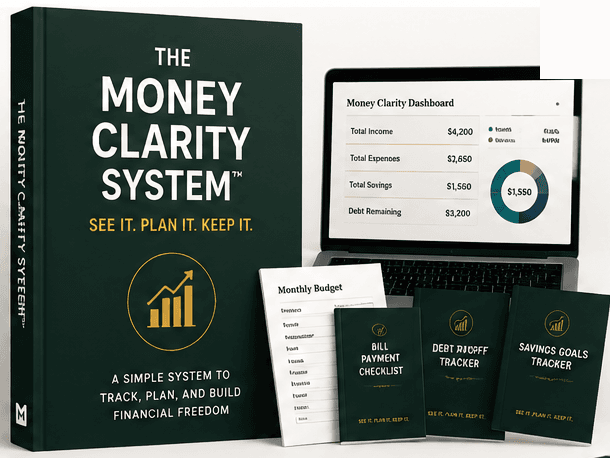
The Money Clarity System™
Ready to actually track it, not just read about it?
The full guide, dashboard, planner, challenges, and bonuses — one payment, lifetime access.
Related articles

Budgeting
How to Budget on a Low Income
Most budgeting advice assumes there's meaningful room to cut. On a low income, that assumption often doesn't hold — the approach needs to be different, not just smaller.
4 min read

Saving Money
How to Save Money on a Tight Budget
Generic savings advice assumes room that doesn't exist on a tight budget. A smaller, more deliberate approach works better than trying to force a standard percentage.
4 min read

Saving Money
How to Build an Emergency Fund (Even If You're Starting From Zero)
An emergency fund doesn't need to reach 'six months of expenses' to start protecting you. The gap between zero and a few hundred dollars matters more than most advice admits.
5 min read